ESA's Hera Mission Captures First Close-Up Images of DART Impact Crater on Dimorphos
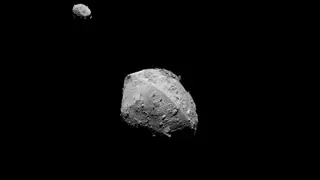
The European Space Agency's Hera mission, launched in 2024, has captured detailed images of Dimorphos, the asteroid targeted by NASA's DART mission in 2022, revealing a massive crater spanning the entire width of the 151-meter-diameter moonlet. The impact significantly altered Dimorphos' orbit and caused it to tumble wildly around its parent asteroid Didymos, providing critical data on planetary defense strategies. Principal investigator Patrick Michel and scientist Michael Kueppers noted the unexpected surface stability despite the large crater, leaving researchers puzzled and intrigued.
In November 2026, the European Space Agency’s Hera mission, launched in October 2024, captured the first close-up images of the crater left by NASA’s DART mission on Dimorphos, a 151-meter-wide moonlet orbiting the larger asteroid Didymos. The impact, executed in September 2022, created a crater spanning the entire width of Dimorphos—comparable in size to a sports stadium—flattening the surface on the side struck. These images, released by ESA, confirm that the impact significantly altered the asteroid’s orbit and induced chaotic tumbling, making Dimorphos the most irregularly rotating object in the solar system. The mission’s instruments, including two CubeSats, are now analyzing the asteroid’s structure, composition, and gravity field to assess how the collision changed its internal makeup. Principal investigator Patrick Michel and scientist Michael Kueppers expressed surprise at the surface’s apparent stability despite the massive crater, noting that the lack of widespread disruption is puzzling and challenges existing models of asteroid response to high-velocity impacts. The mission also discovered hundreds of previously unknown boulders in the system, adding complexity to future studies.
The DART impact was the first real-world test of planetary defense, a strategy conceived to deflect potentially hazardous asteroids. The success of the mission, confirmed by Hera’s data, validates the feasibility of kinetic impact as a method to alter an asteroid’s trajectory. The broader context includes past mass extinctions, such as the Cretaceous-Paleogene event 66 million years ago, which underscored the existential threat posed by asteroid impacts. ESA and NASA are now using the data to refine predictive models for future planetary defense scenarios. What remains unresolved is how such impacts affect long-term orbital stability and whether surface features like boulders or regolith distribution could influence the effectiveness of future deflection attempts. The next phase involves analyzing the full dataset from Hera’s instruments, with results expected to inform international protocols for asteroid mitigation.
The Hera mission’s findings could significantly influence global space policy and planetary defense planning, potentially leading to more robust international cooperation in monitoring near-Earth objects. By validating DART’s success, the mission strengthens the case for investing in kinetic impactors as a viable defense strategy, which may prompt governments to prioritize funding for early detection systems and rapid-response missions. The discovery of chaotic tumbling on Dimorphos may also affect how scientists model asteroid dynamics, particularly for binary systems, which could impact future mission planning and risk assessment. A comparable precedent is the 1994 Shoemaker-Levy 9 comet impact on Jupiter, which galvanized public and scientific interest in planetary defense. However, unlike that event, DART and Hera represent a proactive, human-driven test rather than a natural occurrence. The societal impact may be felt in increased public awareness of space threats and greater support for space agencies. What to watch for next is whether these findings lead to the development of a dedicated planetary defense task force or a standardized protocol for international response to potential threats.