Euclid Space Telescope Unveils First Major Data Release Featuring Over a Billion Cosmic Objects
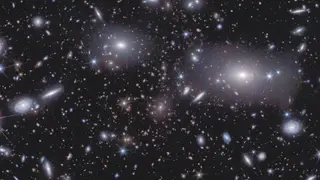
The European Space Agency's Euclid space telescope has released its first major dataset, capturing more than a billion cosmic objects across 13 months of observation. The data includes a massive 500-gigapixel mosaic composed of 740 individual observations, showcasing galaxy clusters like Abell 3128 located 800 million light-years away. This release marks a significant milestone in astronomy, providing the foundation for future discoveries in cosmology and dark matter research.
On November 14, 2026, the European Space Agency (ESA) released the first major dataset from its Euclid space telescope, marking a pivotal moment in observational cosmology. Over 13 months of operation, Euclid captured more than a billion cosmic objects, including galaxies, stars, and galaxy clusters, forming a 500-gigapixel mosaic composed of 740 individual observations. This mosaic includes detailed views of the Abell 3128 cluster, located 800 million light-years away, and the expansive Horologium Supercluster, which spans over 10 billion light-years in distance and contains more than 30 smaller clusters. The data also features high-resolution images of well-known objects such as Messier 81, a spiral galaxy 12 million light-years distant, and NGC 1291, a ring-shaped galaxy dubbed the Golden Eye, situated about 33 million light-years away. Euclid’s primary mission is to map one-third of the sky with high precision, using its visible and near-infrared instruments to study dark matter and dark energy by analyzing cosmic structure and gravitational lensing effects.
The project builds on decades of astronomical progress, including prior surveys like the Sloan Digital Sky Survey and Hubble’s deep field observations, but Euclid is unique in its scale and focus. ESA launched the telescope in 2023 with a goal of revolutionizing our understanding of the universe’s large-scale structure. The data release was spearheaded by Carole Mundell, ESA’s director of science, who emphasized the scientific significance of the dataset as a foundation for future discovery. The Euclid Consortium, involving over 1,000 scientists across Europe and beyond, is now analyzing the data to refine models of dark matter distribution and cosmic expansion. What remains unresolved is how quickly these findings will lead to peer-reviewed breakthroughs or influence upcoming missions like NASA’s Nancy Grace Roman Space Telescope. The full implications of Euclid’s catalog—especially its gravitational lensing database—may not be fully realized for years.
This data release could significantly advance public understanding of the cosmos and inspire renewed interest in space science education and STEM fields. By making high-resolution images of distant galaxies and clusters freely available, Euclid may empower educators, amateur astronomers, and citizen science initiatives to engage with real astrophysical data. The availability of such vast datasets may also stimulate innovation in AI-driven image analysis tools, particularly those focused on pattern recognition in large-scale astronomical surveys. Comparable to the impact of Hubble’s public data releases in the 1990s, Euclid’s early output could catalyze a new wave of open science collaboration across institutions and nations. In the longer term, the findings may influence funding priorities for future space missions and shape policy on international scientific cooperation. However, it remains unclear how quickly these data will translate into tangible discoveries or affect private-sector applications in machine learning and satellite technology. What to watch for next is whether Euclid’s catalog accelerates consensus on dark energy models or reveals anomalies that challenge current cosmological theory.