Lumina Simulation Unveils Secrets of the Early Universe's Dark Ages
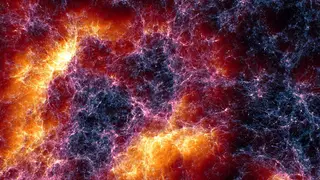
The Lumina simulation, a groundbreaking astrophysical model, recreates conditions across a volume of space over 1.5 billion light-years wide with unprecedented detail, capturing phenomena from dark matter filaments to gas dynamics between galaxy clusters. It focuses on reionization, a pivotal phase in cosmic history when the first stars and galaxies ionized neutral hydrogen. The simulation's results were published in the Monthly Notices of the Royal Astronomical Society on October 26, 2026.
The Lumina simulation, published on October 26, 2026, in the Monthly Notices of the Royal Astronomical Society, models a cubic volume of space over 1.5 billion light-years wide—spanning roughly 50 million years after the Big Bang to about 2 billion years post-Big Bang—with unprecedented resolution. It tracks physical conditions across 432 billion spatial sectors, resolving structures as small as 1,400 light-years while capturing large-scale phenomena like dark matter filaments and gas dynamics between galaxy clusters. The simulation focuses on reionization, the epoch when the first stars and galaxies emitted ultraviolet radiation that stripped electrons from neutral hydrogen atoms, transforming the universe from opaque to transparent. This period remains poorly understood due to observational limitations, making simulations essential for probing its timing, mechanisms, and the roles of dark matter and early stellar populations.
The scientific foundation for Lumina builds on decades of astrophysical modeling, including earlier efforts like the IllustrisTNG and EAGLE simulations, which struggled with either scale or resolution. The breakthrough here lies in combining extreme computational power with advanced algorithms that balance detail and efficiency across multiple scales. Led by a collaboration centered at the Center for Astrophysics | Harvard & Smithsonian, the project involved an international team of astrophysicists aiming to resolve long-standing questions about cosmic structure formation and energy sources during the early universe’s “dark ages.” The team’s goal is not just to replicate observations but to test theories about how galaxies formed, how radiation propagated, and how dark matter influenced large-scale structure.
What remains unresolved includes the exact timeline of reionization—whether it was gradual or sudden—and the relative contributions of early stars versus black holes. Future work may involve comparing Lumina’s predictions with data from upcoming telescopes like the James Webb Space Telescope and the Square Kilometre Array, which could detect faint signals from this era. The simulation’s success may also inspire new computational frameworks for modeling other cosmic epochs.
The Lumina simulation could significantly influence how cosmology is taught and funded, shifting public and institutional focus toward computational astrophysics as a core investigative tool. By offering a virtual window into the universe’s formative period, it may reshape expectations for what constitutes “evidence” in astronomy—where simulations now play a role comparable to observational data. This could affect academic hiring, grant allocations, and infrastructure investment in high-performance computing centers. In broader societal terms, such advances may inspire renewed public interest in space science, particularly among students and tech-savvy audiences who view simulations as accessible gateways into complex physics. Comparable to how the Hubble Deep Field images transformed public perception of cosmic scale in the 1990s, Lumina’s visualizations could become iconic representations of scientific discovery. The impact may also ripple into AI and data science fields, where the algorithms developed for such simulations could be adapted for climate modeling, materials science, or even medical imaging. However, these effects remain speculative—what is clear is that the simulation underscores a growing trend: that understanding the universe increasingly depends on computational power rather than just telescopes. The next phase may involve real-time interactive models accessible to researchers and educators alike, potentially democratizing access to cosmic exploration.