AWS and NVIDIA Partner on Unified Framework for Deploying AI Models to Robots
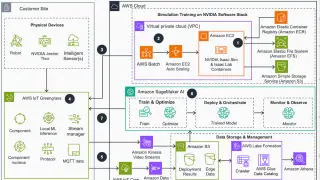
Amazon Web Services has released an open-source toolchain that integrates AWS and NVIDIA technologies to streamline the development pipeline for roboticists, covering synthetic data generation, model training, simulation, validation, and edge deployment. The platform addresses a critical gap in robotics development by providing a unified workflow that connects multiple steps required to move trained AI models from simulation to real-world robot operation. The toolchain leverages components including SageMaker for training and Isaac Sim for simulation, allowing developers to focus on solving robotics problems rather than managing infrastructure.
The toolchain represents AWS and NVIDIA's response to a fundamental bottleneck in robotics development: the difficulty of transitioning models from controlled environments to unpredictable real-world settings. By integrating synthetic data generation with simulation and edge deployment capabilities, the platform attempts to reduce the manual work required to operationalize AI systems across diverse robotic hardware. The inclusion of feedback mechanisms allows deployed robots to continuously improve their models, addressing the challenge that robotics lacks the abundant training datasets available in other AI domains.
The release follows AWS's discontinuation of RoboMaker in 2025, suggesting a strategic pivot toward a more modular, open-source approach. The framework's hardware-agnostic design reflects recognition that the robotics industry encompasses varied applications—from controlled warehouse environments to dynamic retail spaces—each presenting distinct operational constraints and safety requirements.
This initiative could democratize advanced robot development for smaller companies unable to build custom infrastructure pipelines, potentially accelerating robotics adoption across industries. However, the framework's effectiveness may vary significantly depending on domain specificity and sim-to-real transfer challenges. Widespread deployment could reshape labor markets and operational models in logistics, retail, and manufacturing, though the pace of meaningful real-world adoption remains uncertain. The open-source model may foster innovation but could also concentrate power among organizations with resources to implement sophisticated systems.