Rhoda AI Leverages Internet-Scale Video Data to Train Generalized Robotics Models
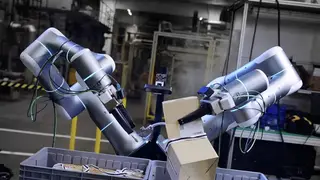
Rhoda AI is developing direct video action (DVA) models trained on vast internet-scale video datasets to improve robots' understanding of physical interactions and real-world variability. The company, backed by $450 million in Series A funding, integrates mobility and manipulation into a single policy using mobile DVA, aiming to overcome limitations of prior robotics training methods. Co-founder and CEO Jagdeep Singh emphasizes that current models fail in real-world settings due to lack of robust data, unlike large language models trained on extensive text sources.
Rhoda AI, based in Palo Alto, California, emerged from stealth in early 2026 with $450 million in Series A funding to develop Direct Video Action (DVA) models trained on internet-scale video data for robotics. The company’s core innovation lies in using vast, diverse video datasets—spanning decades of content including sports, nature, and everyday human activity—to pretrain AI models that generalize across physical interactions. Unlike prior approaches relying on limited, task-specific robot teleoperation data, Rhoda’s DVA model processes sequences of video frames, language tokens, and action history to predict future scenes and convert them into executable robot actions in real time. This closed-loop system enables robots to adapt dynamically to changing environments by continuously observing, predicting, acting, and re-observing. The mobile DVA extension integrates mobility and manipulation into a single policy, allowing the same model to control different robot embodiments after minimal task-specific fine-tuning—typically 10 to 20 hours—similar to onboarding a new human worker.
The company’s approach stems from a recognition that physical AI has lagged behind large language models (LLMs) due to the absence of a comparable data foundation. While LLMs benefit from petabytes of text, robotics has historically depended on curated, narrow datasets that fail under real-world variability. Rhoda AI’s co-founder and CEO, Jagdeep Singh, argues that even non-human-centric videos—like crashing waves or blowing trees—contribute to the model’s understanding of physics and motion. This broad data strategy, rejecting earlier assumptions about human-centric video superiority, has led to models with greater generalization across tasks and hardware. Rhoda AI positions itself as a full-stack provider, offering flexible deployment options: it can supply both the AI layer and physical robot bodies or integrate with third-party hardware and skill training. The company is initially targeting manufacturing and logistics sectors, where labor shortages and offshoring trends create urgent demand for autonomous solutions.
What remains unresolved is how well these models will perform at scale across diverse industrial environments beyond controlled demonstrations. The long-term viability of internet-scale video pretraining—especially regarding data privacy, bias, and computational cost—is also untested in real-world robotics deployment. Additionally, the extent to which Rhoda AI’s model can generalize across vastly different robot morphologies or unforeseen physical scenarios remains to be seen.
Rhoda AI’s DVA approach could significantly accelerate the adoption of autonomous robots in industries like logistics and manufacturing, where labor shortages and operational inefficiencies persist. By leveraging internet-scale video data—akin to how LLMs were trained on global text—the company may overcome the brittleness that has plagued prior robotics systems, enabling machines to handle real-world unpredictability. If successful, this could disrupt traditional automation models reliant on rigid programming or limited training data, potentially reducing reliance on offshoring and reshoring supply chains. The model’s ability to generalize across robot embodiments may also lower entry barriers for companies wanting to deploy AI-driven automation without investing in custom hardware or software from scratch. However, broader societal impacts remain uncertain. The use of uncurated internet video raises concerns about data provenance, privacy, and potential biases embedded in training content—issues that could lead to discriminatory or unsafe behaviors in deployed robots. Comparable to the early days of generative AI, where models absorbed problematic content from the web, Rhoda’s approach may face scrutiny over accountability and transparency. The success of this model could also reshape the robotics industry, pushing competitors toward similar data-driven strategies or forcing a reevaluation of data collection ethics. What to watch for next is whether Rhoda can demonstrate consistent real-world performance across diverse settings, how regulatory bodies respond to unregulated training data sources, and whether other companies adopt or challenge this paradigm.