UC Berkeley and NVIDIA Unveil AI Agents That Code Industrial Robots Without Training Data
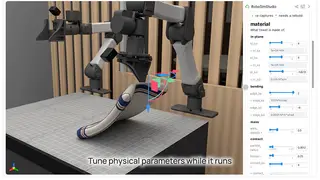
UC Berkeley and NVIDIA have introduced open-source tools enabling teams of AI agents to autonomously write, simulate, and refine robot programs for industrial applications without relying on pre-existing training data. The framework, called GaP, breaks tasks into modular skills like perception and motion planning, while VABAR provides a benchmark with six standardized robotics challenges. The system was presented at CoRL 2026 and aims to transform robotic programming by allowing rapid iteration and human-verifiable code generation.
In November 2026, UC Berkeley and NVIDIA unveiled GaP (Graph-as-Policy) and VABAR (Variational Automation Benchmark for Agentic Robotics), open-source tools enabling AI agents to autonomously generate, simulate, and refine robot programs for industrial applications without relying on pre-existing training data. The framework was presented at CoRL 2026 in Austin, Texas, and leverages the Newton physics engine and Isaac Lab-Arena for simulation and evaluation. GaP breaks complex robotic tasks—such as perception, grasp planning, and collision-free motion—into modular skills that AI agents can independently generate, connect, and test in simulation. VABAR provides a standardized benchmark with six real-world manipulation challenges: tool sorting, tool hanging, gear meshing, syringe packing, cable insertion, and cable routing, each featuring varying difficulty levels and success metrics. The system was developed around RoboSimStudio, an interface created by UC Berkeley graduate student Eric Chen to simplify Newton’s complex parameter space, making it accessible for AI agents to tune autonomously. This innovation addresses longstanding bottlenecks in industrial robotics, where programming traditionally required weeks or months of manual tuning after physical installation. Ken Goldberg, a leading figure in robotics at UC Berkeley, emphasized that this shift from data-heavy, hand-tuned systems to agentic loops enables rapid iteration and human-verifiable code generation. The collaboration between UC Berkeley and NVIDIA, including Spencer Huang of NVIDIA’s robotics product team, aims to accelerate the deployment of autonomous robotic systems across manufacturing and automation. What remains unresolved is whether these tools can scale beyond lab environments into diverse, unstructured industrial settings, and how regulatory or workforce dynamics may respond to such rapid automation advancement.
This development could significantly disrupt traditional robotics workflows in manufacturing, potentially reducing programming time from months to hours and lowering barriers for small-scale adopters. By enabling AI agents to generate and verify code without training data, the technology may democratize access to advanced automation, empowering firms that previously lacked in-house robotics expertise. The shift may also reshape roles within engineering teams, shifting focus from low-level coding to oversight, validation, and system-level design—similar to how CAD software transformed drafting in the 1980s. However, concerns about job displacement, especially for technicians involved in robot commissioning, remain unaddressed in the current reporting. The broader robotics industry may see increased competition between open-source frameworks like GaP and proprietary systems, potentially accelerating innovation cycles. If widely adopted, such tools could influence standards in industrial automation, pushing vendors toward more interoperable and simulation-ready platforms. What to watch for includes real-world deployment trials beyond controlled benchmarks, the emergence of new certification requirements for AI-generated code, and how workforce training programs adapt. The success of GaP and VABAR may also inspire similar agentic frameworks in other domains like autonomous vehicles or logistics, where rapid adaptation to dynamic environments is critical.