Voyager 1 Crosses One Light-Day Milestone in Deep Space
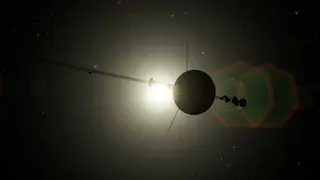
NASA's Voyager 1 spacecraft has become the farthest human-made object from Earth, reaching a distance of one light-day—approximately 16 billion miles—after nearly 50 years of exploration. The achievement, confirmed by signals received at NASA's Jet Propulsion Lab, marks a historic milestone in interplanetary travel and continues to inform future missions like Europa Clipper and Dragonfly. Scientists emphasize the mission's enduring legacy in expanding our understanding of the outer solar system.
On November 19, 2026, NASA’s Jet Propulsion Lab confirmed that Voyager 1 had reached a distance of one light-day—approximately 16 billion miles—from Earth, marking the farthest any human-made object has ever traveled. The signal confirming this milestone was received at 5 A.M. EST on Thursday, though the spacecraft had crossed the threshold the previous day due to the 16-hour communication delay inherent in deep space. Launched in 1977 alongside Voyager 2, the twin probes were originally designed for a five-year mission to study Jupiter, Saturn, Uranus, and Neptune. After completing their primary objectives, both spacecraft continued into interstellar space, where they now operate beyond the heliosphere—the sun’s protective bubble. Voyager 1, now 50 years old, is expected to lose power and cease communications with Earth by 2036, though it will continue drifting through space toward a target 17 light-years away. The spacecraft carries the Golden Record, a time capsule of Earth’s culture and life, intended for potential extraterrestrial discovery.
The mission’s enduring legacy is evident in current and upcoming NASA endeavors. Data from Voyager’s exploration of Jupiter’s moon Europa and Saturn’s moon Titan have directly informed the design and goals of the Europa Clipper (set to arrive in 2030) and the Dragonfly mission (launching in 2028). Despite aging systems and power constraints—leading NASA to shut down several instruments earlier in 2026—scientists continue to extract valuable data on cosmic rays, plasma waves, and magnetic fields in interstellar space. Project managers like Suzanne Dodd, Nicky Fox, and Kareem Badaruddin emphasize the mission’s inspirational role and the team’s ongoing efforts to solve technical anomalies. What remains unresolved is the exact timeline of Voyager 1’s final operational phase and how long it will take for its data stream to fully cease. The spacecraft’s continued function beyond 2036 remains unknown, but its symbolic and scientific impact is already cemented.
The milestone of Voyager 1 reaching one light-day from Earth underscores the enduring value of long-duration space missions, even as hardware ages. While the immediate impact is largely symbolic—reinforcing public awe for space exploration—the broader influence lies in how such missions shape future scientific priorities. The data from Voyager continues to inform the design and objectives of missions like Europa Clipper and Dragonfly, demonstrating how foundational exploration can enable targeted, high-impact research decades later. This model may influence how agencies like NASA prioritize long-term investment in deep space infrastructure, especially as private space ventures increasingly seek to extend human presence beyond Earth. A comparable precedent is the Hubble Space Telescope, which, despite initial technical setbacks, revolutionized astronomy and inspired generations of scientists and engineers. Voyager’s legacy may similarly fuel interest in interstellar travel and the search for extraterrestrial life. What to watch for next is whether the success of Voyager’s extended mission encourages more robust, long-term funding for deep space probes, particularly those with dual scientific and cultural significance. The mission’s continued operation could also inspire new educational initiatives or public engagement campaigns focused on space heritage and the long arc of human curiosity.