Astronomers Observe Dying Star Consuming Smaller Companion in Andromeda Galaxy
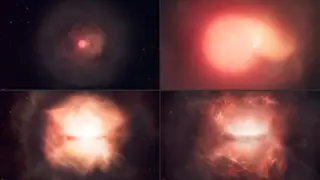
Astronomers have captured the first real-time observation of a dying star, an asymptotic giant branch (AGB) star with about seven times the mass of the Sun, consuming its smaller companion in the Andromeda galaxy. The event, detected through data from the WINTER telescope and NEOWISE space telescope starting in 2018, shows the larger star's expanding envelope engulfing its neighbor, a process that may result in a single, rejuvenated stellar remnant. The findings, published in Nature, confirm long-standing theoretical models of stellar engulfment in binary systems.
In October 2023, astronomers using the WINTER telescope at Palomar Observatory and NASA’s NEOWISE space telescope detected a dramatic brightening in the Andromeda galaxy, a signal that traced back to 2018. The event, now identified as the first real-time observation of a stellar engulfment, involved a dying asymptotic giant branch (AGB) star—seven times the mass of the Sun—consuming its smaller companion. The larger star, with a bloated, puffy envelope typical of AGB phase evolution, had drawn its neighbor into a close orbit due to gravitational interactions, culminating in a collision when the smaller star plunged into the core of the larger one. The resulting “dramatic eruption” was captured by the SPHEREx space telescope, which observed the system dimming before the merger event. The system, designated WNTR23bzdiq/WTP19aalzlk, is located 2.5 million light-years from Earth, making it the first known case of such a merger involving an old, evolved star rather than a young, compact one. Prior theoretical models had predicted that a companion entering an AGB’s envelope could either trigger a merger or eject the companion, but this observation confirms the merger scenario. The collision ejected vast amounts of hot dust, obscuring the system in near-infrared wavelengths, though scientists expect it to cool and stabilize within decades. Viraj Karambelkar of Columbia University, a NASA Hubble Fellow and lead co-author, emphasizes that the event’s rarity—occurring on a timescale of years rather than billions of years—makes it a pivotal moment in observational astrophysics. What remains unknown is the final state of the remnant: whether it will be a rejuvenated star with unusual magnetic fields, chemical compositions, or luminosity patterns, which will only become clear after years of continued monitoring.
This discovery could reshape how astronomers model binary star evolution and stellar mergers, particularly in the late stages of stellar life. While previous observations of stellar collisions involved young, dense stars, this event demonstrates that even aging, expanded stars can undergo violent mergers, potentially altering long-held assumptions about stellar end states. The findings may influence future telescope mission planning, especially for infrared and time-domain surveys like SPHEREx, which are crucial for capturing transient phenomena. Institutions like NASA and the European Space Agency may prioritize similar surveys to detect more such events, possibly leading to new observational protocols for transient detection. A comparable earlier case is the 2019 observation of a star being consumed by a black hole, which similarly revealed a rare, real-time astrophysical event. However, unlike that case, this merger could result in a new kind of star with exotic properties, potentially offering insights into stellar rejuvenation and the origins of unusual chemical signatures in space. The broader impact may extend to public understanding of cosmic events, making complex astrophysics more tangible through dramatic, real-time stories. What to watch for next is whether follow-up observations reveal a stable, long-lived remnant with anomalous characteristics—could this be a prototype for a new class of stars? The answer may emerge over the next decade, shaping both theoretical models and future observational strategies.