Hidden Massive Neutron Star Candidate Detected in Distant Binary System
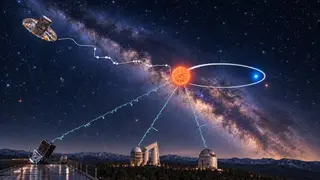
Astronomers have identified an invisible, massive object orbiting a red giant star in the Pisces constellation, inferred through gravitational effects on the visible star. The object, named J0008+0128, is likely a supermassive neutron star—more massive than typical neutron stars—based on data from LAMOST, APOGEE, and Gaia. This discovery could challenge existing models of stellar evolution and compact object formation.
In November 2026, astronomers identified a mysterious, massive object orbiting a red giant star in the Pisces constellation, designated J0008+0128, based on gravitational perturbations detected through data from China’s LAMOST, the APOGEE survey, and ESA’s Gaia observatory. The invisible companion, estimated to have a mass between 1.8 and 2.8 times that of the Sun—peaking at 2.2 solar masses—is unusually heavy for a neutron star, which typically max out around 1.4 solar masses. This anomaly challenges current models of stellar evolution, particularly how compact objects form and gain mass. The system’s wide orbital separation rules out accretion from the red giant as a source of mass, making traditional explanations insufficient. Researchers considered two main possibilities: either neutron stars can be significantly more massive than previously thought—implying gaps in understanding supernova physics—or the object formed from a rare merger of two white dwarfs, possibly within a triple system. However, the object’s circular orbit suggests a gentler formation process, which may favor a low-mass black hole over a neutron star. Scott Ransom of the National Radio Astronomy Observatory noted that such a circular orbit is more consistent with a quiet black hole birth than the violent kick typical of neutron star formation. Despite extensive radio surveys, no pulsations were detected—ruling out a standard neutron star—but definitive confirmation remains elusive without X-ray observations.
This discovery could influence how astrophysicists model stellar death and compact object formation, potentially reshaping textbooks and simulations. If confirmed as a supermassive neutron star, it would imply that supernova mechanics or core-collapse dynamics are not fully understood—possibly prompting new theoretical work and observational campaigns. The possibility of a low-mass black hole challenges the conventional belief that such objects are rare or undetectable in our galaxy, which may stimulate renewed interest in searching for similar candidates. Institutions like NASA, ESA, and China’s National Astronomical Observatories may prioritize follow-up missions with X-ray telescopes to resolve the nature of J0008+0128. Comparable to the 2017 detection of gravitational waves from a neutron star merger, this case could catalyze interdisciplinary collaboration between observational astronomy and theoretical modeling. While no immediate technological or economic impact is expected, it may influence funding priorities in high-energy astrophysics. What to watch for next: whether future X-ray missions like Lynx or Athena can detect emissions, and whether similar systems are found in large-scale sky surveys—could signal a broader population of extreme stellar remnants.