NVIDIA Unveils New AI Tools for Scientific Research at SC26
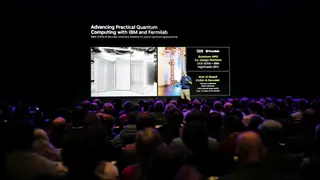
Ian Buck, NVIDIA's vice president of hyperscale and high-performance computing, introduced new AI agent tools at SC26 in Chicago, including Nemotron for Science, a platform enabling researchers to run experiments locally using open models and datasets. The announcement also featured the Rubin HPC GPU, an expanded Vera CPU platform, and a collaboration with IBM and Fermilab on quantum computing. These tools aim to accelerate scientific discovery by combining simulation, AI, and autonomous agents.
At SC26 in Chicago on November 17, 2026, NVIDIA’s Ian Buck unveiled a suite of new tools aimed at accelerating scientific research through AI agents, high-performance computing (HPC), and quantum collaboration. Central to the announcement was Nemotron for Science, an open platform combining the Nemotron 3.5 Super VL model with a new open chemistry dataset and specialized post-training recipes for life sciences and chemistry. Researchers can deploy it locally on systems like the DGX Spark workstation or existing supercomputers. The tool demonstrated real-world impact at Argonne National Laboratory, where an agent generated hypotheses, planned simulations, and identified two novel protein binding sites from a single prompt. Other agents highlighted included one from KTH Royal Institute of Technology that repaired 81% of broken GROMACS setups overnight on a single DGX Spark, and another used by the SETI Institute to autonomously retune the Allen Telescope Array for methanol detection with a one-line command. The Rubin HPC GPU, part of the Vera Rubin platform, is designed for science and AI workloads, supporting FP64 to FP4 precision, sparse data acceleration, and seventh-gen NVLink connectivity, with over 50,000 CUDA cores—about three times more than Hopper—and expected in 2028. The expanded Vera CPU platform, already adopted by Texas Advanced Computing Center and now selected by DKRZ for its HLRE-5 supercomputer (launching early 2028), is optimized to support the computational loops required by AI agents. NVIDIA also announced a quantum co-design initiative with IBM and Fermilab, integrating DGX B200 systems with IBM Quantum Nighthawk machines, while introducing TCBP-JOBS, a CUDA-Q algorithm that reduces quantum error-correction computation from 12 weeks to just 45 minutes. The event marked a milestone in Buck’s two-decade journey since his first CUDA talk at SC06.
NVIDIA’s SC26 announcements signal a shift toward autonomous scientific discovery, where AI agents act as co-researchers capable of planning experiments and interpreting results with minimal human intervention. This could democratize access to high-end computational tools, enabling smaller labs and institutions to conduct complex simulations previously limited to national supercomputing centers. The emphasis on open models and local deployment—such as Nemotron for Science running on DGX Spark systems—may reduce reliance on cloud-based infrastructure, addressing concerns over data privacy and vendor lock-in. The integration of quantum computing research through partnerships with IBM and Fermilab could accelerate progress in error correction, a critical bottleneck in scalable quantum systems. Comparable to how CUDA revolutionized GPU programming two decades ago, these tools may become foundational for next-generation scientific workflows. However, challenges remain: widespread adoption depends on the usability of agent frameworks, the availability of high-quality open datasets, and the reliability of autonomous decision-making in sensitive research domains. The long-term societal impact could include faster drug discovery, improved climate modeling, and breakthroughs in materials science—though ethical oversight and reproducibility standards will need to evolve alongside the technology. What to watch for: how quickly researchers adopt these tools, whether open models can match proprietary alternatives in performance, and whether quantum co-design efforts yield tangible hardware advances within the next five years.