NVIDIA Unveils Advanced Simulation Tools to Enhance Robot Precision in Complex Tasks
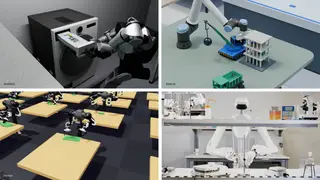
NVIDIA is advancing robotic autonomy at the Conference on Robot Learning by introducing GR00T 2 and Isaac Lab 3.0, enabling robots to master intricate manipulation tasks like gear alignment and cable connection through high-fidelity simulation. The company’s new world action models and open benchmarks allow for scalable training and evaluation of robot policies across diverse environments. These tools, developed in collaboration with academic and industry partners, aim to bridge the gap between lab experiments and real-world industrial deployment.
At the 2026 Conference on Robot Learning (CoRL) in Austin, Texas, NVIDIA unveiled GR00T 2 and Isaac Lab 3.0, marking a significant leap in robotic manipulation through high-fidelity simulation. GR00T 2, an open frontier world action model built on NVIDIA Cosmos, was trained on 100,000 hours of human egocentric video data and demonstrated strong out-of-the-box performance—completing 40 of 50 tasks without task-specific demonstrations. It achieved 71% success with just one demonstration per task, rising to 95% with five, and supports skill transfer across different robot bodies without needing physical demonstrations. Isaac Lab 3.0, the latest version of NVIDIA’s open-source robot-learning framework, now integrates Newton, an open physics engine, enabling accurate simulation of deformable objects like cables and cloth, as well as complex articulated systems such as robotic hands. The tools were developed in collaboration with academic and industry partners including UC Berkeley, Siemens, Flexion, Noitom Robotics, and Ambi Robotics. These advancements aim to bridge the gap between lab-based robot experiments and real-world industrial deployment by enabling scalable training and evaluation across diverse environments.
The shift from locomotion to fine manipulation reflects a broader trend in robotics toward agentic systems—AI agents that generate interpretable code for physical actions. NVIDIA’s two CoRL paper finalists, GRAIL and RoboTTT, highlight progress in generating 3D assets and scaling visuomotor context without increasing inference latency. The company is also promoting open workflows like Video to Data, which converts human video into simulated robot demonstrations, and the EgoHand model, which reconstructs 3D hand motion and has seen over 40,000 downloads on Hugging Face. While these tools are already being tested by companies like Foxconn and Nexuni for factory automation and laundry handling, full-scale industrial adoption remains unproven. What remains unresolved is how well these simulation-trained policies will generalize across real-world variability, especially in dynamic or unstructured environments.
NVIDIA’s advancements could significantly accelerate the deployment of autonomous robots in manufacturing, logistics, and domestic settings, potentially reducing labor costs and increasing precision in repetitive or delicate tasks. The open nature of GR00T 2 and Isaac Lab 3.0 may democratize access to high-end robotic training tools, empowering startups and academic labs that previously lacked the resources for such development. This could reshape the robotics ecosystem, favoring companies that integrate simulation-to-reality pipelines efficiently. A comparable precedent is the impact of open-source deep learning frameworks like TensorFlow and PyTorch on AI research—these lowered entry barriers and catalyzed innovation across industries. Similarly, NVIDIA’s move may spur a wave of new applications in industrial automation and service robotics. However, challenges remain: real-world performance may still lag behind simulation due to unmodeled variables like sensor noise or material wear. The long-term success will depend on how well these models adapt to unforeseen physical conditions. What to watch for next is whether other tech firms replicate this open approach or attempt to lock users into proprietary ecosystems, and how quickly regulatory bodies respond to the growing autonomy of robotic systems in public and industrial spaces.