South Korea Leverages NVIDIA's Compute Power to Drive Real-World AI Innovation in Manufacturing and Mobility
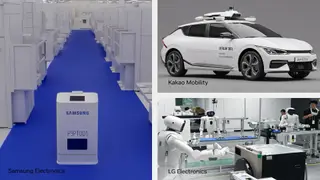
NVIDIA is collaborating with leading Korean firms like Samsung and Kakao Mobility to accelerate physical AI applications across semiconductor engineering, robotics, and autonomous vehicle development. Samsung is using NVIDIA's accelerated computing and AI physics tools to enhance simulation speed and efficiency in chip design and materials research. These advancements are enabling faster prototyping and real-world deployment of complex systems.
In November 2026, South Korea intensified its push into physical AI innovation through strategic collaborations with NVIDIA, leveraging advanced computing infrastructure across key industries. Samsung Electronics is using NVIDIA’s cuISS, cuDSS, and cuEST tools to accelerate simulations in semiconductor engineering, achieving up to a 5x speedup in quantum chemical calculations via the sMOL platform. Notably, Samsung’s integration of AI-predicted material properties with GPU-accelerated coarse-grid simulations delivered a 1,600x improvement—reducing simulation time from 18 hours on a 32-core CPU to just 41 seconds. These advancements are rooted in Korea’s longstanding strength in semiconductor manufacturing and its national focus on next-generation tech leadership. Meanwhile, Kakao Mobility is developing a Level 4 autonomous driving system using NVIDIA Hyperion and DRIVE AGX Thor platforms, with initial testing planned on Kia-built vehicles in Seoul’s Gangnam district, aiming to deploy real-world mobility services. LG Electronics partnered with NVIDIA to demonstrate Isaac GR00T-powered robotic manipulation using its CLOiD robot in live manufacturing settings, creating a closed-loop data flywheel involving real-world data, Cosmos-based augmentation, and Jetson AGX Thor onboard processing. These efforts reflect a broader trend of integrating AI-driven simulation with physical systems—driven by Korea’s industrial base and strategic investment in AI infrastructure. What remains unclear is the timeline for commercial deployment of these systems beyond pilot phases, as well as how regulatory frameworks will adapt to real-time autonomous decision-making in public spaces.
The integration of NVIDIA’s accelerated computing into South Korea’s manufacturing and mobility sectors could significantly reshape industrial automation and urban transportation. By enabling faster design cycles and more reliable simulations, companies like Samsung and LG may reduce time-to-market for complex hardware systems, potentially boosting Korea’s global competitiveness in semiconductors and robotics. Kakao Mobility’s focus on Level 4 autonomy in a dense urban environment like Gangnam presents a real-world testbed that could influence future standards for autonomous vehicle safety and deployment. The use of AI-driven data flywheels may also set a precedent for how industrial AI systems evolve through continuous learning, potentially reducing reliance on manual testing. A comparable earlier case is the adoption of simulation in automotive design during the 2010s, which transformed R&D timelines but required extensive regulatory oversight. Here, similar challenges may arise as physical AI systems make real-time decisions in public infrastructure. What to watch for includes how Korea’s regulatory bodies will balance innovation with safety, and whether other nations adopt similar public-private tech partnerships to scale physical AI. The success of these pilots could signal a broader shift toward AI-native industrial development, where simulation and real-world feedback are tightly coupled—potentially reshaping global supply chains and workforce demands in high-tech manufacturing.