Hybrid Aerial-Marine Robot Transitions from Flight to Autonomous Water Navigation
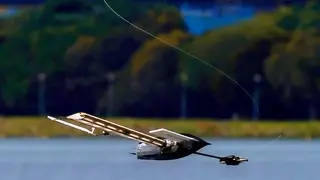
Researchers have developed ALBATROSS, a hybrid robot capable of transitioning between air and water environments without specialized landing gear. The system autorotates during descent to water, automatically rights itself after impact, and then repurposes its rigid wings as sails for wind-powered autonomous movement. The video compilation also showcases a self-assembling modular arm designed for disaster response applications and drone operations in flood-affected regions.
ALBATROSS represents a significant advancement in multi-environment robotics by eliminating the need for traditional landing infrastructure. The system's design philosophy centers on passive mechanical solutions—using autorotation during descent rather than active braking systems, and leveraging natural forces like wind for propulsion once in aquatic environments. This approach reduces complexity and energy requirements compared to conventional amphibious platforms.
The research demonstrates practical applications beyond basic proof-of-concept, with complementary work on modular robotic arms addressing immediate humanitarian needs. Flood response scenarios, particularly in regions like Nepal mentioned in the reporting, highlight how aerial-aquatic transition capabilities could enable rapid deployment and sustained operations in disaster zones where infrastructure is compromised.
This development could expand disaster response capabilities in flood-prone regions by enabling single platforms to survey affected areas and operate across varied terrain without repositioning. The hybrid design may reduce deployment costs for organizations managing emergency operations. However, real-world adoption would depend on scaling reliability, developing operator training protocols, and integrating these systems with existing emergency management workflows. The technology's impact on employment in specialized recovery roles remains uncertain.