Boston Dynamics Equips Atlas Humanoid with Wheels to Explore Advanced Locomotion Control
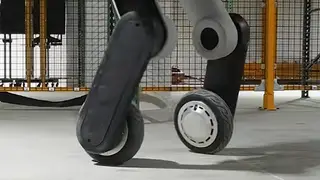
Boston Dynamics has modified its Atlas humanoid robot by adding wheels to its feet, enabling dynamic movement across varied terrains using a blend of traditional motor control and whole-body reinforcement learning. The experiment, designed as a research testbed rather than a product, demonstrates Atlas's ability to switch seamlessly between wheeled rolling and legged motion while adapting in real time to unmodeled disturbances. The system was trained entirely in simulation and executed complex maneuvers like pirouettes with high accuracy in the real world.
On November 9, 2026, Boston Dynamics unveiled a modified version of its Atlas humanoid robot equipped with wheels attached to its feet, marking a significant step in testing advanced locomotion control. The experiment, conducted by controls engineer Andy Wu, involved retrofitting the robot with off-the-shelf scooter rims using a single custom adapter mounted on existing ankle actuators—making the modification as simple as swapping a bicycle wheel. This wheeled Atlas was not intended as a product but as a research testbed to explore hybrid locomotion strategies. The system was trained entirely in simulation, where it learned dynamic behaviors such as rolling on flat terrain and performing pirouettes, then executed them with high accuracy in the real world. The core innovation lies in combining classical model-based motor control for stability with whole-body reinforcement learning (RL) to adapt in real time to unmodeled disturbances and uneven surfaces.
This development builds on Boston Dynamics’ long-standing focus on agile, dynamic robots, exemplified by earlier versions of Atlas that emphasized bipedal walking and acrobatic motion. The shift toward wheeled locomotion reflects a broader engineering challenge: how to balance predictable, efficient movement with the adaptability needed for real-world unpredictability. Wu’s work aims to understand control synergy—how deterministic physics-based systems can coexist with learning-based policies to improve resilience. While Boston Dynamics insists this is not a product path, the experiment signals interest in hybrid mobility solutions. Meanwhile, competitors like Agility Robotics are also exploring wheeled configurations, though they maintain that their Digit robot will likely remain legged. The unresolved question centers on how much human-like form is necessary for commercial utility and whether future robots will prioritize efficiency over anthropomorphism.
The integration of wheels into Atlas could signal a broader industry pivot toward hybrid mobility in humanoid robotics, where efficiency and adaptability are balanced through modular design. If successful, such systems may become more viable for real-world deployment in logistics, disaster response, or industrial settings—environments where speed on flat surfaces and agility over obstacles are both critical. The approach may influence how companies like Hyundai, which is ramping up Atlas testing at its facilities, evaluate robot performance and scalability. While the immediate impact remains limited to research, this experiment could inspire new standards in robot control architecture, favoring systems that blend simulation-trained learning with real-time feedback. A comparable precedent is the evolution of autonomous vehicles, where early models relied heavily on pre-programmed rules but now integrate machine learning for dynamic decision-making. The key difference here is the physical embodiment—robots must manage both balance and motion across diverse terrains. What to watch for next: whether other firms adopt similar hybrid designs, how regulatory bodies respond to increasingly complex robot behaviors, and whether public perception shifts toward accepting non-humanoid forms as equally capable in human-centric environments.