Ancient Rock Art Unearthed in Spanish Cave: 280 Engravings Reveal Prehistoric Life
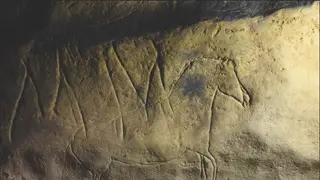
Archaeologists have uncovered 280 Paleolithic engravings in a cave in northeastern Spain, including depictions of horses, deer, and a rare bear. The discovery, made in Cova de la Font Major—a site previously visited by thousands—reveals intricate carvings that had remained hidden despite decades of foot traffic. Researchers believe the engravings may have been overlooked due to their subtle nature and the cave’s dim lighting.
In November 2026, researchers uncovered 280 Paleolithic engravings at Cova de la Font Major, a cave in Espluga de Francolí, Catalonia, northeastern Spain—despite decades of tourism and prior excavation dating back to 1957. The site, previously known for its accessibility and visitor traffic, had long been traversed by thousands without revealing its hidden artistic treasures. Among the engravings are 55 animal figures, including horses, deer, and a rare bear depiction, along with abstract forms such as parallel lines and clusters of loops. The discovery was made during systematic surveys beginning in 2019, led by Josep Maria Vergès Bosch and Míriam Salas-Altès from the Catalan Institute of Human Paleoecology and Social Evolution (IPHES-CERCA) and the University of Rovira i Virgili. These researchers suggest that the engravings remained undetected due to their subtle nature, dim lighting conditions, and visual confusion with modern graffiti. The site’s prior use as a tourist destination may have contributed to accidental damage, including vandalism by visitors unaware they were defacing ancient art. This discovery is significant because such Paleolithic rock art is exceptionally rare in Catalonia—only two previous examples had been documented in the region, compared to the well-known Franco-Cantabrian cave sites along the Spain-France border. Salas-Altès and her team now aim to interpret the engravings’ meanings and explore whether the cave served ritual, sheltering, or other purposes. Unopened sediment-filled galleries within the cave may yet yield additional findings.
The discovery at Cova de la Font Major could reshape public understanding of prehistoric human activity in inland Iberia, challenging assumptions that artistic expression was concentrated only in western and northern regions. As a site previously open to tourism, its protection now raises questions about balancing heritage access with preservation—similar to the challenges faced at Lascaux in France, where controlled access was eventually mandated after damage from over-visitation. The use of modern research techniques, including detailed photogrammetry and systematic surveying, may inspire similar re-examinations of other “well-known” archaeological sites globally. If such engravings are found elsewhere in Spain or Europe, it could shift funding priorities toward non-traditional rock art regions. Institutions like IPHES-CERCA may gain greater influence in shaping conservation policies. The story also highlights how scientific progress often depends on revisiting old data with new tools—suggesting that many undiscovered or overlooked archaeological records may exist in plain sight. What remains uncertain is whether the engravings represent symbolic communication, spiritual practice, or daily life documentation. Future research could reveal deeper insights into early human cognition and cultural continuity across Europe.