Shrinking Tokenizer Vocabularies to Lower Small-Model Serving Costs
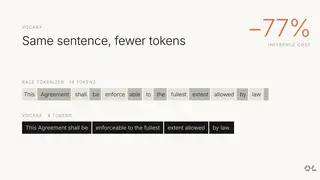
A production essay-grading system built on Qwen3-4B reduced its measured serving expense by 77% by redesigning the tokenizer for Portuguese and the expected JSON output. The authors kept the base model, training data, and training procedure unchanged, and describe a method called VocabX that prioritizes token cost over token frequency. The article previews results from a forthcoming paper.
The system described is a live Portuguese essay grader built on Qwen3-4B. It accepts an essay, prompt, and supporting texts, then returns JSON containing a grade and comment for each competency. Its inherited tokenizer had 151,669 entries and was designed for broad multilingual and multi-domain use, not this narrow task.
VocabX rebuilds the vocabulary by weighing the expense of tokens more heavily than how often they occur. The authors report a 77% reduction in measured serving cost without swapping the underlying model, altering its training examples, or changing how it was trained; the results come from a paper still under review.
Lowering serving costs for narrow language tasks could make automated essay feedback more affordable for schools, assessment providers, and other high-volume users. It may also encourage teams deploying small open models to treat tokenizer design as a cost lever rather than a fixed inheritance. The effect is likely uneven: groups with the skills to rebuild vocabularies may benefit most, while others may wait for reusable tooling.