Frontier AI Models Accelerate Physics Simulation Development Through Natural Language
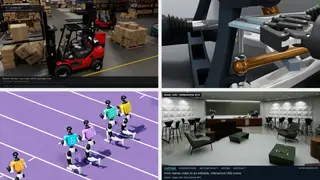
Developers are leveraging advanced AI models like GPT-6 Astra alongside NVIDIA Omniverse libraries to streamline the creation of physics-based simulations through natural language instructions. The approach combines GPU-accelerated rendering, physics engines, and sensor simulation to enable developers to rapidly prototype and iterate on complex scenarios ranging from warehouse automation to autonomous vehicle testing. This integration allows teams to direct AI agents to automatically generate code, connect simulation components, and validate physical behavior without manual assembly of disparate systems.
The workflow described combines natural language interfaces with specialized GPU-accelerated libraries that handle physics calculations, visual rendering, and sensor simulation simultaneously. Rather than manually coding each component, developers verbally direct AI agents to orchestrate these functions, automatically generate supporting code, and verify that virtual environments behave correctly before deployment.
Three concrete applications demonstrate the approach's versatility: warehouse robotics simulation with interactive controls, autonomous vehicle testing across environmental variations, and sensor validation through comparison of simulated versus real-world camera and LiDAR data. Each project required iterative refinement guided by developers, suggesting the AI agents function as assistants rather than fully autonomous system builders.
This development pattern could significantly reduce the barrier to entry for creating complex simulations, potentially accelerating adoption across robotics, autonomous systems, and industrial automation sectors. Faster prototyping and validation cycles may enable broader exploration of edge cases and failure modes before physical deployment. However, organizations may need to carefully evaluate whether AI-generated simulation code maintains necessary safety properties and accurately represents real-world physics, particularly in applications affecting autonomous vehicle behavior or industrial safety systems.