Boston Dynamics Redesigns Atlas Hand With Four Fingers for Manufacturing Tasks
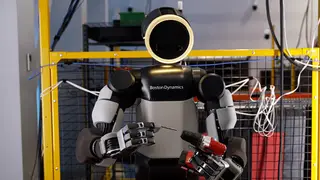
Boston Dynamics unveiled a redesigned hand for its Atlas humanoid robot featuring four fingers and 13 degrees of freedom, prioritizing tool manipulation and manufacturing capabilities over dexterity. The company determined that adding a pinky finger would introduce unnecessary complexity without sufficient benefit in performing industrial tasks like operating drills and welding torches. The new hand uses direct actuation and is optimized for simulation-based reinforcement learning to enable practical deployment in automotive manufacturing.
Boston Dynamics made deliberate engineering trade-offs when developing the new Atlas hand, prioritizing functional reliability for industrial work over biomimetic complexity. The design process involved testing whether a fifth finger would meaningfully improve manufacturing capabilities; leadership even asked team members to tape their pinky fingers for a day to evaluate real-world impact. The resulting four-finger configuration delivers 13 degrees of freedom while reducing power consumption and actuator count compared to adding a fifth digit.
The hand's architecture emphasizes direct actuation with proprioceptive feedback and tactile sensing across the fingertips and palm. This approach enables the robot to recover from grasp slips and manipulate triggering mechanisms on industrial tools. The hand maintains a size comparable to a large human hand, balancing the need to grasp varied objects and access confined spaces while preserving cross-embodiment compatibility with human manipulation data for training purposes.
The four-fingered design could influence how manufacturing companies approach automation over the next decade, potentially reducing deployment costs and maintenance complexity compared to more anatomically complex alternatives. Workers in automotive manufacturing may see accelerated integration of Atlas units into production lines, which could shift labor demands toward robot supervision and maintenance roles. The emphasis on task-specific engineering rather than human replication may establish an industry precedent favoring pragmatic design over biomimicry, affecting how competing robotics firms approach their own development strategies.