Data Company Launches Motion-Capture Facility to Accelerate Humanoid Robot Training
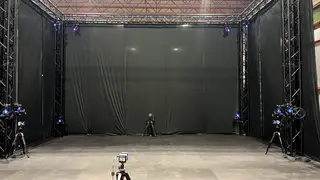
Innodata has established a new laboratory equipped with high-precision motion-capture technology to generate training data for humanoid and industrial robots. The facility uses Vicon cameras to record 3D movement data directly from bodies at sub-millimeter accuracy, addressing a critical shortage of real-world interaction data needed to develop more capable physical AI systems. The lab will also independently validate performance metrics that robots generate, helping compress development timelines and improve robot safety.
Innodata's new facility employs Vicon camera systems to record movement at sub-millimeter precision, capturing three-dimensional data directly from bodies rather than inferring it from video footage. This approach addresses a fundamental challenge in physical AI development: robots require extensive real-world interaction examples to learn tasks safely and effectively, yet collecting such data through traditional means remains prohibitively expensive and time-consuming.
Beyond data generation, the laboratory serves a secondary function by independently testing and validating performance metrics that robotic systems report internally. This dual capability—both training data production and third-party verification—aims to accelerate development cycles while enhancing safety assurance for robotics companies working across humanoid, industrial, and other physical AI applications.
The advancement could reshape how quickly robotics companies bring autonomous systems to market and how reliably those systems perform in uncontrolled environments. Workers in manufacturing and service industries may experience faster deployment of robotic assistance, potentially improving workplace efficiency or raising concerns about labor displacement. The emphasis on safety validation through independent testing could influence regulatory frameworks governing autonomous systems, while improved training data quality might increase the accessibility of advanced robotics development beyond large, well-resourced organizations.