H Company Introduces Holo4 Open-Source Models for Cross-Platform Agentic Computer Interaction
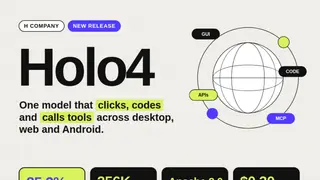
H Company released Holo4, an open-weight vision-language model family designed for AI agents to interact with graphical interfaces, write code, and call external tools across multiple platforms. The release includes two configurations—Holo4 27B and Holo4 35B-A3B (Mixture of Experts)—both supporting 256K context and deployable on desktop, web, Android, and API environments. Benchmarking shows Holo4 27B achieves 85.2% on OSWorld with substantially lower inference costs compared to frontier closed-source models.
H Company's release addresses a practical limitation in current AI agent architecture: most existing systems either require graphical interfaces to function or rely on APIs that many applications lack entirely. By creating a unified model that operates consistently across desktop environments, web browsers, mobile platforms, and programmatic interfaces, Holo4 enables agents to handle real-world workflows where multiple interaction modalities are necessary.
The training methodology reflects substantial infrastructure investment. H Company constructed approximately 10,000 verified tasks spanning multiple software categories, then performed supervised fine-tuning on 127 billion tokens of successful agent trajectories. A two-expert reinforcement learning approach specialized different model components for distinct interaction types before merging them, while architectural improvements to the agent harness—particularly memory management and shell access—addressed key failure points identified in earlier systems.
Holo4's combination of open-weight availability and cross-platform capability could democratize access to capable automation agents for organizations unable to rely on closed-source frontier models. Reduced inference costs may enable broader deployment in enterprise and consumer applications. However, the performance gap on complex multi-step workflows and the reliance on training data from specific benchmark sources suggest practical limitations remain. Availability of self-hosted, commercially licensed weights could accelerate adoption by enterprises prioritizing data privacy and control, while open licensing may advance research into agent-based systems.