Liquid AI Introduces Decision-Focused Model for Structured Classification Tasks
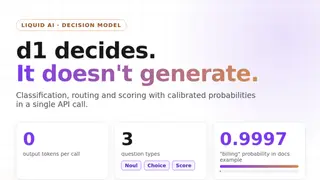
Liquid AI has released d1, a specialized model designed for making structured decisions rather than generating text, returning calibrated probability distributions across predefined options in a single inference pass. The model addresses common machine learning tasks such as classification, routing, scoring, and moderation by evaluating context against typed questions without producing output tokens. d1 is currently available as a hosted API and supports three primitive question types: yes/no questions, multiple-choice selection, and rubric-based scoring.
Liquid AI's d1 represents a departure from general-purpose language models for tasks requiring deterministic outputs. Rather than generating text tokens sequentially, the model processes input and returns probability distributions across predetermined categories in a single inference pass. This architectural choice eliminates common pain points in classification workflows: token billing for minimal outputs, variable latency from generation loops, and JSON formatting failures from model hallucinations.
The model supports three fundamental question types that cover most structured decision scenarios. Boolean questions produce confidence scores, categorical selection returns ranked options with confidence metrics, and rubric-based scoring maps inputs to ordered levels. Multiple question types can be evaluated simultaneously against the same input, reducing the number of API calls required for workflows that previously demanded sequential LLM invocations.
D1's availability could influence how organizations approach common machine learning operations like content moderation, ticket classification, and data quality checks. Teams might reduce operational costs by eliminating output token charges for classification tasks and decreasing inference latency. However, broader adoption would depend on whether the API-only deployment model and three primitive question types prove sufficiently flexible for domain-specific classification problems that sometimes require custom logic or fine-tuning capabilities.