Hands-On with Google Research's MSEB: Building Sound Encoders and Testing Them Across Four Evaluation Tasks
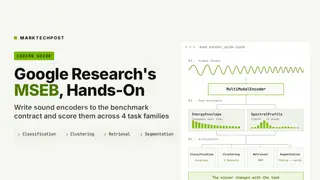
This tutorial walks through Google Research's Massive Sound Embedding Benchmark (MSEB) by implementing custom sound encoders against its abstract base class. It uses synthetic audio to exercise classification, clustering, retrieval, and segmentation evaluators and inspects the metrics each one rewards. The exercise shows that encoder rankings can change depending on the evaluator, supporting the benchmark's multi-task design.
MSEB, Google Research’s Massive Sound Embedding Benchmark, is structured in three layers: shared types such as Sound, SoundEmbedding, Score, and TaskMetadata; the MultiModalEncoder contract that custom models implement; and evaluator modules for task families. The tutorial installs mseb 0.1.0 and works entirely on CPU with synthetic audio, so no dataset download is needed.
It defines two contrasting encoders—one based on loudness over time, another on timbre—and scores them through classification, clustering, retrieval, and segmentation. Because the encoders exchange ranks across evaluators, the exercise illustrates the benchmark’s multi-task rationale. Lighter evaluators rely on NumPy and scikit-learn, while reranking and transcription involve Whisper and the task runner uses TensorFlow and apache-beam.
This work could affect machine-learning researchers, audio engineers, and product teams choosing sound embeddings, because evaluator choice may change which model appears best. A multi-task benchmark may encourage more balanced encoders and clearer reporting, potentially improving reliability in audio search, classification, and segmentation applications. For end users, such evaluation practices may indirectly shape the quality of audio AI tools, though the tutorial’s synthetic, CPU-only scope means its immediate societal reach is likely limited.