AugLy and PyTorch Tutorial for Multimodal Augmentation and Robustness Testing
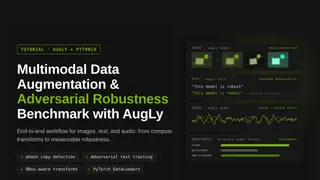
This tutorial demonstrates an end-to-end pipeline for augmenting image, text, and audio data with AugLy and testing model robustness. It sets up reproducible synthetic datasets, handles dependency issues, and explores AugLy's functional and class-based interfaces, metadata, intensity tracking, probabilistic composition, and bounding-box-aware transforms. The workflow also benchmarks perceptual-hash copy detection under image distortions, evaluates text classifiers against adversarial and Unicode-based perturbations, and connects AugLy transformations to PyTorch datasets and DataLoaders.
The tutorial targets reproducibility by installing AugLy without dependencies and adding compatibility shims for NumPy aliases and PIL font measurement. It creates deterministic synthetic images with ground-truth boxes, then applies image, text, and audio transforms.
It compares function-based and object-oriented APIs, records metadata and transformation strength, composes transforms probabilistically, and supports bounding-box-aware and custom operations. Later sections benchmark perceptual-hash copy detection under distortions, test text classifiers against adversarial and Unicode obfuscation, and link augmentations to PyTorch datasets and DataLoaders.
This workflow could help researchers and engineers build more reproducible robustness tests for multimodal models, affecting teams working on content moderation, copy detection, and accessibility. By standardizing augmentation and evaluation, it may expose brittleness to distortions, Unicode tricks, or adversarial text, potentially leading to more reliable systems. Its impact depends on adoption and on how closely synthetic benchmarks reflect real-world data.