Fastino Unveils GLiNER2.5-Decide, a CPU-Capable Open-Weight Decision Model
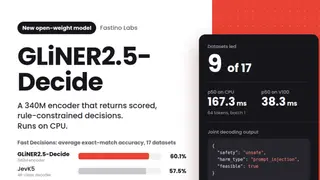
Fastino Labs released GLiNER2.5-Decide, a 340M-parameter open-weight classifier for structured decisions in agent pipelines. It accepts text plus a schema of typed questions and returns answers with probabilities, confidence, and constraint-feasibility metadata, using a DeBERTa-v3-large encoder and constrained joint decoding. The Apache 2.0 weights can run on CPU, GPU, or air-gapped systems, with hosted inference and fine-tuning also offered.
Fastino Labs released GLiNER2.5-Decide on September 24, 2026, a 340 million-parameter open-weight decision model designed for structured, non-generative classification in agent pipelines. Built on a DeBERTa-v3-large encoder and fine-tuned from gliner2-large-v1, the model processes input text alongside a schema of typed questions—each with defined answer types, constraints, and rules—and returns answers with probabilities, confidence scores, and feasibility metadata. It supports single- or multi-label outputs, ordered values, and complex rule-based dependencies via constrained joint decoding. The model is released under the Apache 2.0 license, enabling deployment on CPU, GPU, or air-gapped systems, with optional hosted inference and fine-tuning via the GLiNER API. Benchmarks on Fastino’s internal Fast Decisions suite of 5,100 examples across 17 datasets show a 60.1% average exact-match accuracy, outperforming larger models like JevK5 (4B) and SemIf Qwen3.5-4B. Notably, it led in nine of the 17 tasks, excelling in intent routing with 75.3% accuracy on support intent and 64.3% on banking intent. Latency performance is strong: 167.3 ms p50 on a 48-vCPU Intel Xeon system, and as low as 38.3 ms on an NVIDIA V100 for short inputs.
The model’s design reflects a strategic shift toward lightweight, rule-aware decision engines in agentic AI, addressing the limitations of independent classification—such as conflicting outputs—by enforcing logical consistency across related judgments. Fastino’s focus on joint decoding, particularly for safety guardrails, demonstrates a move toward reliable, auditable decision-making in high-stakes environments like banking or clinical operations. The company also released a 1-billion-parameter variant (GLiNER2.5-Decide-1B) and a multilingual version (GLiNER2.5-multi-Decide), indicating a broader ecosystem strategy. While Fastino is the primary actor, the model’s open weights and API support suggest a broader ambition to standardize structured decision-making in AI systems. What remains unresolved is how widely this approach will be adopted beyond Fastino’s internal benchmarks, and whether third-party developers will integrate it into production agent workflows. The long-term impact on model architecture trends—especially in reducing reliance on large generative models for operational tasks—remains to be seen.
GLiNER2.5-Decide could reshape how AI agents make operational decisions, particularly in regulated or high-precision domains like finance, healthcare, and cybersecurity. By enabling structured, rule-consistent judgments without generating text, it may reduce hallucination risks and improve auditability—key concerns in deploying AI in sensitive workflows. Its CPU compatibility and open licensing lower barriers for organizations with strict data governance or limited compute, potentially democratizing access to robust decision infrastructure. This may shift investment away from massive generative models toward specialized, efficient classifiers, especially in enterprise and government applications. A comparable precedent is the rise of lightweight models like DistilBERT, which offered a balance between performance and efficiency, enabling wider deployment. Here, the innovation lies not just in size but in the integration of constraint-aware inference, which could become a new standard for agent reliability. However, the model’s performance on external benchmarks remains unverified, and its real-world robustness against adversarial inputs or schema drift is still unknown. The next phase will likely involve third-party adoption, integration into agent frameworks like LangChain or AutoGen, and potential competition from other open-weight decision models. Watch for whether this approach becomes a de facto standard in AI safety and routing systems.