Aikido Security Launches Altar-1, a Compressed Open-Weight Security Model
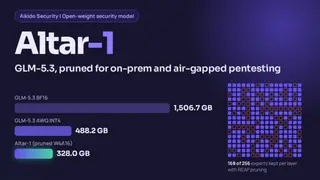
Aikido Security has introduced Altar-1, an open-weight model for security work that is a compressed derivative of Z.AI's GLM-5.3. The model is designed for customer-controlled or air-gapped deployments and powers Aikido Machine, an autonomous pentesting appliance. It was created by quantizing routed expert weights to 4-bit and pruning 88 of 256 experts per layer, with weights available on Hugging Face and support for vLLM on four H200 GPUs.
Altar-1 is Aikido Security's first open-weight security model, derived from Z.AI's GLM-5.3. It is intended for customer-controlled and air-gapped environments, and it drives Aikido Machine, an autonomous pentesting appliance. The public checkpoint runs with vLLM on four NVIDIA H200 GPUs and requires Hopper-class hardware.
Construction combined an AWQ INT4 parent with REAP expert pruning. Each layer retains 168 of 256 routed experts, dropping 88, while routing still activates eight experts per token and roughly 40B parameters. The result is 328 GB, 78.2% below BF16 and 32.8% below the AWQ parent. Calibration used pentesting traces plus coding, tool-calling, reasoning, and multilingual Wikipedia text, with no customer data.
Altar-1 could shift some security AI workloads toward locally controlled infrastructure, especially for banks, industrial operators, and air-gapped teams that cannot send code or findings to external services. A compressed open-weight model may reduce deployment costs and enable autonomous pentesting, though four H200s remain a significant requirement. Its narrow benchmark means real-world gains are uncertain; adoption may depend on independent validation and whether organizations trust vendor-reported results.