Liquid AI's New Optimization Speeds Up Vision-Language Model Inference
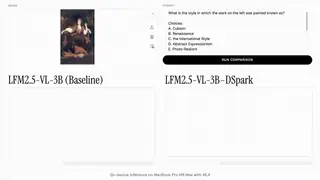
Liquid AI has shared a new technique to accelerate vision-language models, specifically targeting their LFM2.5-VL-DSpark model. The approach reportedly improves inference speed without compromising performance. Details are available on the Hugging Face blog.
This announcement centers on a practical efficiency gain for vision-language models, which combine visual understanding with text generation. The technique, applied to Liquid AI’s LFM2.5-VL-DSpark model, aims to reduce the computational cost of inference—the process of generating outputs after training. Faster inference is a persistent bottleneck for deploying large multimodal systems on real-world hardware, especially in edge or low-latency settings. By sharing the method on Hugging Face, the company contributes to a broader open-source trend where model optimization recipes are made public, allowing developers to replicate or adapt the approach without waiting for proprietary releases. The claim of maintaining performance while speeding up processing is a common goal in the field, though independent verification would typically follow.
Faster vision-language inference could lower the barrier for deploying such models in everyday applications—like real-time image captioning, assistive robotics, or automated content moderation—where speed matters. If the technique proves robust, smaller teams and startups may adopt it, reducing energy costs and hardware requirements. However, gains are often model-specific, so broader impact depends on generalizability. Users might see more responsive AI tools, but developers must weigh trade-offs in accuracy or complexity. The open-source sharing also encourages community scrutiny, which could accelerate innovation but also fragment best practices.