New Benchmark Tests How Well Interpretability Tools Read Model Internals
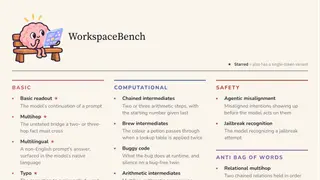
Researchers introduced WorkspaceBench, a benchmark of 3,356 questions across 27 families to evaluate activation-to-text interpretability tools on reading a model's global workspace. It includes a hallucination-focused subset and was developed for Qwen-3.6-27B, with expectations that it may need adaptation for smaller models. The goal is to provide a proxy for practical utility in model auditing and to guide development of better interpretability tools.
The benchmark targets a persistent problem in interpretability: confirming that tools genuinely read model internals rather than reconstructing answers from prompts. Tasks are designed so intermediate variables are likely necessary for correct responses, reducing shortcut opportunities. A dedicated hallucination subset tests whether tools fabricate workspace content instead of faithfully reporting it.
WorkspaceBench was calibrated for Qwen-3.6-27B, selected for its strong internal representations. The researchers note that smaller models may lack sufficient computational sophistication to hold clear workspace variables, potentially requiring task adaptation. The benchmark is open-sourced, enabling researchers to evaluate new interpretability tools against a standardized measure.
The benchmark could influence how AI developers assess model safety before deployment. If interpretability tools reliably read model internals, auditors may gain better visibility into hidden reasoning, particularly for models operating without chain-of-thought. This may affect regulatory expectations around transparency and could shape research priorities. However, reliance on a single model family means broader applicability remains uncertain, and impact will depend on whether tool developers adopt it as a standard evaluation.