Physicists' Approach to LLM Pruning: Treating Block Removal as an Ising Model
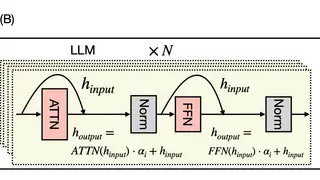
A new blog post describes a method for pruning large language models by framing the removal of model blocks as an Ising optimization problem, a concept borrowed from statistical physics. The approach aims to identify which blocks can be removed with minimal impact on performance, potentially enabling more efficient model compression. This technique could offer a novel way to reduce model size while preserving accuracy, relevant to open-source AI development.
This technique reframes model compression as a physics problem, treating each block as a spin in a lattice. By mapping removal decisions to an Ising model, the optimization seeks the lowest-energy configuration—meaning the set of blocks whose absence least disrupts the network's output. This statistical mechanics lens offers a principled alternative to heuristic pruning, potentially allowing developers to systematically evaluate trade-offs between size and performance. For open-source projects, such methods could lower the barrier to deploying large models on limited hardware, though the summary does not specify benchmarks or implementation details.
The approach reflects a broader trend of importing mathematical frameworks from other disciplines into machine learning. While the post is conceptual, it suggests that rigorous optimization from physics may complement existing compression strategies like quantization or distillation. The practical value hinges on whether the Ising formulation scales to models with hundreds of blocks and whether the identified removals generalize across tasks.
This method could affect AI developers and researchers who rely on open-source models, potentially enabling smaller, faster deployments on consumer devices or edge hardware. If effective, it may reduce computational costs and energy use, broadening access to advanced AI. However, the impact depends on whether pruning preserves reliability in real-world applications—any degradation could undermine trust. The approach also hints at deeper cross-disciplinary collaboration, but its societal reach remains speculative until validated.