Icarus Robotics validates free-flying space station robot during parabolic flights
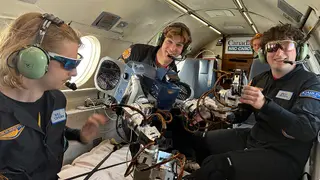
Icarus Robotics completed a series of parabolic flights to test its free-flying robot Joy, which is designed to handle cargo and logistics aboard the International Space Station. The robot performed 66 parabolas across four flights, accumulating two minutes of weightlessness while validating its manipulation, state estimation, and flight control systems. The company plans to finalize Joy's flight hardware for NASA handover in January, ahead of a planned ISS launch in 2027.
The parabolic flight campaign marked the final major validation milestone before Icarus finalizes Joy's flight hardware for NASA handover in January. Because teleoperation wasn't possible aboard the aircraft, the team recorded manipulation trajectories in their Brooklyn office and replayed them during microgravity windows, benchmarking performance between terrestrial and zero-G conditions. The robot's seven-degree-of-freedom arms, built entirely in-house, were the primary focus across roughly half the campaign.
Joy is designed to autonomously navigate the ISS's pressurized interior, using pinch grippers to handle cargo and logistics tasks that currently consume significant astronaut time. The company raised $6.1 million in seed funding last year and has been scaling the system toward production readiness. The robot is slated to reach the ISS in 2027 under the Joyride-1 mission, managed through an agreement with Voyager Technologies announced in March.
If Joy performs as intended on the ISS, it could meaningfully shift how astronaut labor is allocated in orbit, potentially reducing time spent on routine cargo handling and allowing more focus on scientific research. Success may also accelerate interest in free-flying robots for future commercial space stations, where crew time will be at a premium. However, the technology remains unproven in sustained orbital conditions, and its broader impact will depend on reliability demonstrated during actual ISS operations beginning in 2027.