Hugging Face Launches New Benchmark Dashboard for AMD's Ryzen and Radeon Chips
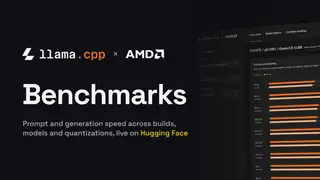
Hugging Face has introduced a new benchmark dashboard in collaboration with ggml-org to evaluate the performance of llama.cpp on AMD Ryzen and Radeon hardware. The tool enables developers to compare inference speeds across different models, quantizations, and builds, measuring prompt processing (PP512) and text generation (TG128) in tokens per second. It supports specific AMD GPUs including the Radeon 8060S and Radeon AI Pro R9700S, with results and methodology publicly available for inspection.
On November 26, 2026, Hugging Face launched a new benchmark dashboard in collaboration with ggml-org, specifically designed to evaluate the performance of llama.cpp on AMD’s Ryzen and Radeon hardware. The tool focuses on two key metrics: prompt processing (PP512) and text generation (TG128), measured in tokens per second, with results available for two AMD GPUs—Radeon 8060S (gfx1151) and Radeon AI Pro R9700S (gfx1201). The dashboard enables developers to compare inference speeds across different models, quantizations (like Q4_K_M, Q8_0, BF16), and llama.cpp builds, with data collected weekly via automated workflows using the llama-bench tool. The benchmarking process includes Flash Attention both enabled and disabled, and results are stored in a public Hugging Face Storage Bucket, allowing full transparency and reuse. The models tested include Inkling 2 Mini, Qwen, Gemma, gpt-oss, and LFM, representing both dense and mixture-of-experts architectures.
This initiative builds on earlier efforts like the release of llama.cpp v1.0.0 and the development of llama-install.sh, which streamlined local AI deployment. The collaboration with AMD reflects a strategic push to validate and optimize open-source models on non-NVIDIA hardware, addressing long-standing concerns about GPU vendor lock-in. ggml-org, led by Simon Pagezy and Abdennacer Badaoui, aims to empower developers with verifiable, reproducible performance data, while Hugging Face provides the platform and infrastructure for public access. AMD’s involvement suggests a broader industry shift toward open, accessible AI tools that reduce reliance on proprietary cloud services. However, the dashboard currently covers only two specific GPUs, leaving many other AMD and non-AMD devices untested. Future expansion—such as support for additional models, quantizations, or hardware—remains unconfirmed, and the long-term impact on developer adoption and hardware choice is still uncertain.
This benchmark dashboard could significantly influence how developers evaluate and choose local AI hardware, particularly for those seeking alternatives to NVIDIA’s dominance in the GPU market. By providing transparent, reproducible performance data, it may accelerate the adoption of AMD’s GPUs in edge computing, privacy-focused applications, and offline AI workflows. Developers working with limited budgets or in regulated environments may benefit from the ability to test models locally without cloud dependencies. The move mirrors earlier industry shifts, such as the rise of open-source Linux distributions challenging proprietary operating systems, where transparency and community validation drove adoption. However, the impact may be limited by the current scope—only two AMD GPUs are supported, and the model set, while diverse, does not include all major LLMs. Broader influence may depend on whether other hardware vendors adopt similar public benchmarking practices. The success of this initiative could also affect software development workflows, encouraging more teams to prioritize cross-platform compatibility and open standards. What to watch for next is whether this model of public, community-driven benchmarking spreads to other AI frameworks or hardware ecosystems, potentially reshaping how performance claims are verified in the AI space.