DARPA’s Final Triage Challenge Tests Robots in Realistic Disaster Scenarios
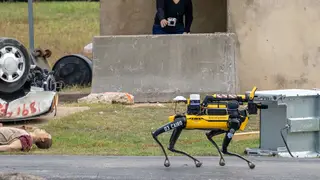
Ten teams competed in a nine-day simulation at Disaster City, a 52-acre mock town in College Station, Texas, to demonstrate how robots and humans can collaborate during mass casualty events. The U.S. Defense Advanced Research Projects Agency (DARPA) hosted the event as part of its three-year Triage Challenge, aiming to improve emergency response through robotics. The competition offered $2.5 million in prize money and featured robots like the University of Maryland’s Spot-based RoboScout system navigating complex, high-stakes disaster environments.
Ten robotics teams participated in the final phase of DARPA’s Triage Challenge, a nine-day simulation held at Disaster City, a 52-acre urban training facility in College Station, Texas. The event, part of a three-year initiative, tested how human-robot teams could collaborate during mass casualty incidents, with the goal of improving emergency response through advanced robotics. The competition offered $2.5 million in prize money, underscoring its significance. Among the standout entries was the University of Maryland’s RoboScout system, which utilized a Boston Dynamics Spot robot to navigate complex, hazardous environments—such as collapsed structures and debris fields—while conducting triage assessments. The robots were tasked with identifying victims, assessing injuries, and relaying data to human responders in real time, simulating high-pressure scenarios like earthquakes or industrial accidents.
The challenge emerged from DARPA’s broader mission to leverage technology for national security and public safety. Previous efforts in robotics, such as those in the DARPA Robotics Challenge (2012–2015), laid groundwork by focusing on disaster response, but this iteration emphasized triage—prioritizing who to treat first—rather than just physical rescue. The University of Maryland team, along with others, aimed to demonstrate that robots could reduce human risk in dangerous zones while enhancing situational awareness. The ultimate goal is to integrate such systems into real-world emergency protocols, potentially transforming how first responders operate. However, key questions remain: how scalable and reliable these systems are outside controlled environments, and whether they will be adopted by public agencies despite cost and training barriers. The next phase may involve field trials with real emergency services, but no official timeline has been announced.
The success of the Triage Challenge could significantly influence how first responders manage large-scale disasters, potentially reducing responder exposure to danger while accelerating life-saving interventions. If proven effective, such robotic systems may become standard in urban search-and-rescue units, changing the dynamics of emergency operations. The integration of AI-driven triage robots may also affect training protocols, shifting focus from purely physical rescue to human-robot coordination. Comparable to the earlier adoption of drones in military reconnaissance, these robots could eventually become as routine in civilian disaster response as fire trucks or ambulances. However, challenges remain: public trust in autonomous systems during life-or-death decisions, data privacy concerns, and the risk of over-reliance on technology. The next step may involve pilot programs with local emergency services, but widespread deployment could be years away. What to watch for is not just technical performance, but how agencies balance automation with human judgment—especially in emotionally charged, high-stakes scenarios.