AI Model Inkling 2 Mini Achieves 190 Tokens Per Second Inference on Single RTX PRO 6000 GPU
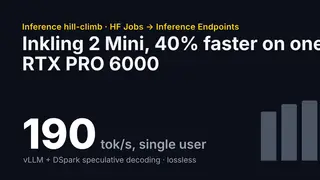
Researchers used an automated coding agent to optimize inference performance of the open-source Inkling 2 Mini model on a single NVIDIA RTX PRO 6000 96 GB GPU, achieving 190.6 tokens per second—up from 136 tokens per second—using vLLM nightly with DSpark speculative decoding. The model, featuring a looped Mixture-of-Experts architecture and a 1 million-token context window, outperforms larger models like Gemma 4 31B and Qwen3.8-27B on multiple benchmarks. The optimized configuration is now deployed as a pinned Hugging Face Inference Endpoint with full reproducibility via public logs and scripts.
On November 25, 2026, researchers led by Niels Rogge achieved a significant milestone in local AI inference by optimizing the open-source Inkling 2 Mini model to deliver 190.6 tokens per second on a single NVIDIA RTX PRO 6000 96 GB GPU using vLLM nightly with DSpark speculative decoding. This marked a 40% improvement over the prior baseline of 136 tokens per second, surpassing earlier community benchmarks and demonstrating that even modest hardware can achieve high performance with the right configuration. The model, which features a looped Mixture-of-Experts architecture with 24 physical layers (effectively 48 due to repetition), a 1 million-token context window, and mixed-precision quantization, outperforms larger models like Gemma 4 31B and Qwen3.8-27B across multiple benchmarks. The optimization was conducted via an automated coding agent that systematically tested configurations using Hugging Face Jobs and the hf CLI, with full reproducibility ensured through public logs and scripts in the NielsRogge/inkling-2-mini-hillclimb repository. The winning setup was deployed as a pinned Hugging Face Inference Endpoint, now accessible over the internet with a latency of 198 ms, including network overhead.
This breakthrough builds on prior work in open-source model efficiency, particularly the growing interest in speculative decoding and framework-specific optimizations. The use of DSpark—a draft model for speculative decoding—was critical, as was the shift from SGLang to vLLM nightly, which better supports the RTX PRO 6000’s architecture (sm120). The team’s decision to use an automated agent reflects a broader trend toward AI-driven optimization, reducing human labor in tuning complex systems. Niels Rogge, an independent researcher, and the Hugging Face ecosystem are central to this effort, with the goal of making high-performance AI accessible without relying on expensive, specialized hardware. What remains unresolved is whether these gains can be replicated across other models or hardware configurations, and how long the vLLM nightly build will remain stable. The next step may involve extending this approach to other MoE models or exploring real-time deployment in edge environments.
This achievement could significantly lower the barrier to entry for developers and organizations seeking to deploy powerful AI locally without cloud dependency. By demonstrating that a single high-end consumer GPU can achieve near-peak inference speeds with open-source tools, it may accelerate adoption of on-device AI for privacy-sensitive applications like healthcare, finance, and personal assistants. The success of automated optimization via a coding agent may also inspire similar experiments across other models, potentially leading to a new class of self-tuning AI systems. Comparable to the 2023 rise of Llama 2, which democratized access to large models, Inkling 2 Mini’s performance may catalyze a wave of innovation in lightweight, efficient AI. However, the reliance on nightly builds and experimental frameworks suggests instability, which could deter enterprise use. The broader impact may be a shift in how AI infrastructure is evaluated—not just by model size, but by real-world efficiency on accessible hardware. What to watch for is whether this optimization methodology becomes standard practice, and whether vendors like NVIDIA or Hugging Face formalize support for such configurations, potentially stabilizing the ecosystem.