Beijing Tops Global Research Rankings in Natural Sciences for 2025, with Chinese Cities Dominating Multiple Fields
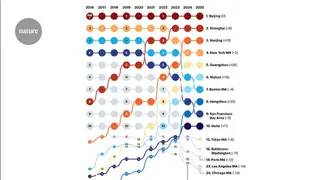
Beijing remained the world’s top city for high-quality research in natural sciences in 2025, according to the Nature Index, maintaining its lead over the past decade. Chinese cities dominated the top 10 in chemistry, with Beijing and Shanghai showing nearly 900% growth in adjusted Share, while five additional Chinese cities entered the top 10 overall. In Earth and environmental sciences, Beijing contributed 25% of China’s total Share, and Qingdao saw the largest percentage increase in adjusted Share between 2016 and 2025.
Beijing has retained its position as the world’s leading city for high-quality natural sciences research in 2025, according to the Nature Index, marking a decade of sustained dominance. The city led in multiple disciplines, contributing 25% of China’s total adjusted Share in Earth and environmental sciences, while Qingdao recorded the largest percentage increase in adjusted Share—545.5%—between 2016 and 2025. In chemistry, Chinese cities occupied all top 10 spots, with Beijing and Shanghai each achieving nearly 900% growth in adjusted Share over the same period. Five additional Chinese cities entered the top 10 overall in natural sciences, reflecting a broad-based national expansion in research output. Meanwhile, two U.S. cities that once ranked in the top 10 have fallen out of the top 20, signaling a shift in global scientific leadership. The data is drawn from the Nature Index, which tracks high-quality research through publication metrics in select journals. This growth follows sustained investment in science infrastructure and talent, particularly in Beijing’s Zhongguancun Science Park and Shanghai’s innovation hubs, supported by government initiatives and funding from bodies like the Beijing Municipal Science & Technology Commission. The Chinese government’s long-term strategy to elevate domestic scientific capability, including AI integration and large-scale research funding, has been instrumental in this rise. The Nature Index supplement, produced with financial support from these institutions, underscores the state’s role in shaping research ecosystems. What remains unclear is the extent to which this growth is driven by quantity versus quality, and whether the current trajectory can be sustained amid global geopolitical tensions and shifting research collaboration patterns.
The shift in scientific leadership toward Chinese cities, particularly Beijing, could reshape global research collaboration networks and influence where high-impact science is conducted. As China consolidates its position in natural sciences, especially in chemistry and Earth sciences, Western institutions may face increased competition for top talent and collaborative opportunities. This could accelerate efforts in the U.S. and Europe to bolster domestic research funding and innovation ecosystems, possibly leading to renewed investment in public science infrastructure. A comparable precedent is the post-Sputnik era, when the U.S. dramatically expanded its science and technology funding in response to Soviet advances. However, unlike that Cold War context, today’s shift is driven by long-term strategic planning and state-backed innovation ecosystems rather than military competition. The implications for global scientific equity are significant—while China’s rise may democratize access to cutting-edge research in certain fields, it could also deepen disparities in research governance and data sharing. The role of AI in accelerating scientific discovery, as hinted at in related articles on AI-powered smart cities, may further amplify China’s lead if its research infrastructure continues to integrate these tools at scale. What to watch for next is whether this momentum translates into breakthrough innovations that influence global policy, such as climate solutions or materials science, and whether international collaboration can maintain resilience amid rising geopolitical friction.