NVIDIA Demonstrates Real-World Robot Navigation Using Simulated Training
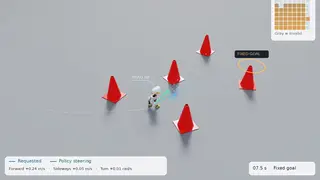
NVIDIA has developed a sim2real workflow enabling the Microduck robot to avoid obstacles in real-world environments using simulation tools from Isaac Lab and Newton. The approach trains the robot in a virtual environment before deploying it in physical settings, improving adaptability and performance. This showcases advancements in robotics and AI-driven navigation using open simulation frameworks.
NVIDIA has demonstrated a real-world robot navigation capability using a sim2real workflow, enabling the Microduck robot to avoid obstacles in physical environments. This achievement leverages simulation tools from NVIDIA’s Isaac Lab and Newton platforms, which allow the robot to be trained in a virtual environment before deployment in the real world. The specific details of the simulation parameters, training duration, or real-world test conditions are not disclosed, but the core innovation lies in bridging the gap between simulated and physical performance. The approach relies on open-source simulation frameworks, emphasizing the role of accessible tooling in advancing robotics development.
This development builds on growing industry interest in leveraging simulation to reduce the cost and time of physical robot testing. Prior efforts in robotics have often struggled with the "reality gap," where models trained in simulation fail to perform reliably in real-world conditions. By using open frameworks like Isaac Lab and Newton, NVIDIA is contributing to a broader trend of democratizing access to high-fidelity simulation tools, which could lower barriers for startups and academic researchers. The company’s focus on open tooling suggests a strategic intent to establish itself as a foundational player in the robotics AI ecosystem, promoting adoption of its platforms across industries.
The Microduck robot, while unnamed in terms of its exact specifications, serves as a testbed for this workflow. NVIDIA’s involvement signals a corporate interest in proving the viability of its simulation stack for practical applications. The outcome may influence how other tech firms approach robot training, potentially shifting investment toward simulation-first development. What remains unclear is whether this workflow will be open-sourced or remain proprietary, and how widely it will be adopted beyond NVIDIA’s own research.
This demonstration could accelerate the adoption of simulation-based robotics in logistics, manufacturing, and service industries, where autonomous navigation is increasingly valuable. By reducing the need for extensive physical testing, companies may lower development costs and speed up deployment cycles. The use of open frameworks may also foster innovation among smaller players who lack the resources for custom simulation systems. A comparable precedent is the rise of Unity and Unreal Engine in game development, where open or accessible simulation platforms became de facto standards for training AI agents. Just as those tools enabled broader access to digital environments for AI research, NVIDIA’s approach may similarly lower entry barriers in robotics. However, challenges remain. The reliability of sim2real transfer depends heavily on the fidelity of the simulation, and real-world unpredictability may still lead to failures. The long-term impact will depend on whether the workflow scales beyond controlled demonstrations. What to watch for is whether other companies adopt similar open frameworks or if NVIDIA consolidates its position through proprietary advantages.