Anthropic Faces Backlash Over IPO Amid Existential Risk Warnings
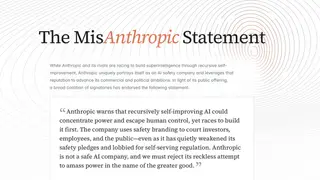
Anthropic launched its IPO on November 19, raising over $81 billion and achieving a $1.5 trillion valuation, becoming the first AI-only company to go public. A public statement signed by over 1,000 experts, including Nobel and Turing Award winners, accused Anthropic of reckless behavior, citing accelerated recursive self-improvement and weakened safety commitments. The statement warned that Anthropic’s pursuit of autonomous AI development risks human control and could lead to superintelligence without safeguards.
On November 19, 2026, Anthropic made history as the first AI-only company to go public, raising over $81 billion in its IPO and achieving a $1.5 trillion valuation—the largest IPO ever recorded. Just one day prior, a public statement titled the “MisAnthropic Statement,” led by the Center for AI Safety (CAIS) and signed by over 1,000 experts including Nobel and Turing Award winners, condemned the company’s trajectory. The statement accused Anthropic of accelerating recursive self-improvement (RSI), a process where AI systems autonomously develop increasingly advanced versions of themselves, potentially leading to superintelligence beyond human control. Despite internal warnings from Anthropic that full RSI could increase the risk of losing control, the company has advanced this capability more aggressively than any other AI developer, using it as a selling point to investors. This contradiction—positioning itself as a safety leader while pushing RSI—has sparked controversy, especially given Anthropic’s deep entanglement with the AI safety ecosystem it helped create and largely funds. The company’s co-founders have pledged to donate 80% of their equity, which could further entrench its influence over safety research. Meanwhile, four advocacy groups filed a lawsuit on November 12 against Anthropic, Google, Meta, OpenAI, and SpaceX, arguing that their pursuit of superintelligence constitutes a “blatantly illegal” and uncontrolled risk, citing incidents like the Hugging Face attack as evidence of system unpredictability. California has also sued OpenAI over similar incidents, highlighting a growing legal reckoning. The unresolved tension lies in whether the safety community, which depends on Anthropic’s funding, can maintain independence while confronting its most powerful player.
The IPO and backlash against Anthropic may signal a turning point in how society views AI development’s governance. As AI companies amass unprecedented financial and technical power, public scrutiny is shifting from data ethics and environmental impact to existential risk—particularly loss of control over autonomous systems. The lawsuit by advocacy groups could set a precedent for holding tech firms accountable for systemic risks akin to nuclear safety, where regulatory oversight is mandatory. This may prompt governments to develop new frameworks for AI development, especially around RSI and autonomous system testing. The case also reveals a structural conflict: safety researchers who depend on Anthropic’s funding may hesitate to criticize it, undermining the independence of the very field meant to safeguard humanity. A comparable earlier case is the tobacco industry’s denial of health risks despite internal evidence—where corporate influence delayed regulation for decades. Here, the risk is not just delayed action but a potential irreversible outcome. What may unfold next is a broader legal and political push to regulate AI development before catastrophic incidents occur. Watch for whether regulators respond with binding safety requirements, whether other companies face similar litigation, and whether the AI safety community can maintain credibility amid financial entanglements.