Evaluating Compute Caps Versus Deployment Lags as AI Safety Pacing Mechanisms
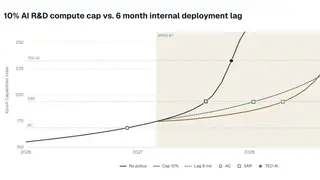
This post compares two policy approaches to slow AI progress: capping the share of compute used for capabilities research versus imposing time delays on model deployment. It finds that while both methods offer similar overall benefits, compute caps more effectively slow early-stage advancement, whereas deployment lags better delay later, higher-capability milestones. The authors suggest combining both strategies for optimal pacing, with a preference for internal-only lags due to greater societal awareness benefits despite higher verification costs.
In November 2026, researchers elifland and romeo published a comparative analysis of two AI safety pacing mechanisms—compute caps and deployment lags—on the AI Alignment Forum, responding to recent advocacy by Evan Hubinger. The study evaluates a 10% cap on compute allocated to capabilities research versus a 6-month deployment lag, both implemented in March 2027, finding that while both reduce the rate of AI advancement, they differ in timing: compute caps more effectively slow early-stage progress (SAR), while deployment lags better delay later, higher-capability milestones (TED-AI). Under a no-China scenario, the lag outperformed the cap in delaying TED-AI by a factor of 3x versus 1.8x, though caps slightly outperformed in SAR-delay scenarios. The authors note that lags may significantly push back the point of no return (PONR) by limiting AI use in alignment research, especially if current-level models are used for AI R&D. They also highlight that internal-only lags—where only internal deployment is restricted—offer greater societal awareness benefits despite higher verification costs, making them preferable to uniform lags. The study acknowledges unresolved questions around safety carve-outs: whether safety research can use non-capacity-optimized compute or lagged models, and how such exceptions affect overall safety outcomes.
This analysis could influence global AI governance by shaping policy debates around how to slow AI progress without stifling innovation. Policymakers may weigh internal-only lags for their transparency and public awareness benefits, even if they require more oversight. The findings may encourage regulators to consider hybrid approaches—combining compute caps for immediate slowdown with deployment lags for long-term structural control. Industries relying on rapid AI iteration, such as tech startups and defense contractors, may face delayed product launches, while safety research organizations could benefit from more time to develop alignment techniques. A comparable precedent is the 1972 Anti-Ballistic Missile Treaty, which used mutual restraint to manage strategic risk. Here, the stakes are similar: preventing irreversible outcomes through coordinated pacing. What remains uncertain is how enforceable such policies would be across nations, especially with China’s potential divergence. The next step may involve pilot programs or multilateral agreements testing these mechanisms in controlled environments.