Quantum Physics Enables Unforgeable Location Verification
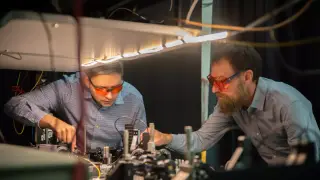
Researchers at the National Institute of Standards and Technology (NIST) demonstrated a method to verify physical location using a single photon and precise timing, leveraging quantum principles that prevent copying of information. The technique relies on the fact that quantum states cannot be duplicated, ensuring that a photon must be measured at its intended location to confirm presence. This breakthrough offers a potential defense against digital impersonation and location spoofing in cybersecurity.
On November 22, 2026, researchers at the National Institute of Standards and Technology (NIST) in Boulder, Colorado, demonstrated a novel method to verify physical location using a single photon and precise timing, published in the journal Nature. The experiment involved two stations nearly 200 meters apart, with a test subject positioned between them. A photon was sent through an optical fiber, and both stations simultaneously transmitted random measurement instructions. The subject had to detect and measure the photon, then respond to both stations. By analyzing the round-trip time of the signal, the researchers could determine with high confidence that the measurement occurred at the intended location, leveraging the quantum principle that quantum states cannot be copied. This property ensures that the photon must be measured at its designated site, preventing spoofing. The work was led by NIST physicists Krister Shalm and Marty Stevens, who developed a quantum echolocation system that could, in theory, allow anyone with a standard device to verify their location to others in a city via a fiber-optic network. The broader motivation stems from growing concerns about AI-enabled scams and digital impersonation, particularly as AI agents become more sophisticated at mimicking human behavior. While the technology is still in early stages—NIST cautions real-world deployment may take over a decade—experts like Columbia University’s Henry Yuen see it as a crucial step toward securing digital identity. However, challenges remain: the system assumes the sender has superior quantum capabilities, and precise measurement of light-speed signals outside controlled environments remains difficult, as noted by University of Tennessee physicist George Siopsis.
This breakthrough could reshape digital trust in an era where location-based identity is increasingly vulnerable to manipulation. If scalable, the technology may enable secure authentication for financial transactions, remote work verification, and even digital voting, reducing reliance on easily forged credentials. The societal impact may be most profound in cybersecurity, where location verification could help distinguish between legitimate users and AI-driven frauds, especially as deepfake and automated phishing attacks grow more convincing. A comparable precedent is the adoption of public key cryptography in the 1990s, which transformed secure communication by making digital signatures verifiable and tamper-resistant. Similarly, quantum location verification may become a foundational layer for trustworthy digital interactions. However, widespread adoption depends on overcoming engineering hurdles in quantum network infrastructure and ensuring compatibility with existing systems. The technology may initially benefit institutions with advanced technical resources—banks, government agencies, or tech firms—potentially widening the digital divide. What to watch for next is whether private-sector investment accelerates development, or if regulatory bodies begin to explore standards for quantum-based identity verification. The real test will be whether the system can function reliably in real-world conditions, beyond the controlled environment of a lab.