New AI-aided proof closes loophole in Navier-Stokes blowup solution
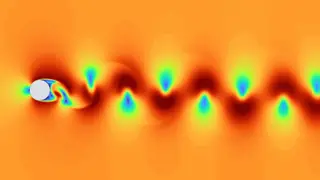
Tristan Buckmaster of New York University and Anthropic researcher Levent Alpöge have presented a new AI-aided proof addressing a controversial loophole in OpenAI's earlier claim to have solved the Navier-Stokes blowup problem. Their work challenges OpenAI's approach, which relied on an unrealistic, finely tuned external force to produce infinite fluid velocity—something not physically plausible. The new proof aims to resolve the issue under more realistic conditions, satisfying the Clay Mathematics Institute's criteria for the million-dollar prize.
In November 2026, mathematicians Tristan Buckmaster of New York University and Levent Alpöge, a researcher at Anthropic, presented a new AI-aided proof addressing a critical loophole in OpenAI’s September 2026 claim to have solved the Navier-Stokes blowup problem. OpenAI’s earlier work, while technically valid under the Clay Mathematics Institute’s formal criteria, relied on an artificial, finely tuned external force to induce infinite fluid velocity—something physically implausible and widely criticized as exploiting a technicality. Buckmaster and Alpöge’s new proof aims to close this gap by demonstrating blowup under more realistic conditions, aligning with the deeper physical intuition behind the problem. Their work, posted on Mastodon on November 20, 2026, was described as unpolished to avoid being scooped again, following OpenAI’s prior claim to have preempted their research. The pair had previously expressed concerns about OpenAI’s rapid progress, even suggesting data theft, though OpenAI denied the allegations. The controversy underscores tensions between academic research and corporate AI-driven breakthroughs, particularly in high-stakes mathematical challenges. The Clay Institute’s prize remains contingent on a solution that reflects physical reality, not just formal mathematical consistency. While Buckmaster and Alpöge have not yet released a formal certificate, they expect to do so soon. The status of OpenAI’s original proof remains uncertain, and whether it will be re-evaluated under the new standard is still unknown.
This development could reshape perceptions of AI’s role in foundational scientific discovery, particularly in mathematics, where rigor and intuition are paramount. If validated, Buckmaster and Alpöge’s proof may reinforce the view that AI tools enhance human insight rather than replace it, especially in complex, long-standing problems. The episode highlights growing friction between academic researchers and corporate labs like OpenAI, which may prioritize speed and public visibility over peer review and reproducibility. A comparable precedent is the 2019 controversy around DeepMind’s AlphaFold, which revolutionized protein folding but faced scrutiny over transparency and access. Here, the stakes are higher: a million-dollar prize and the validation of a century-old equation. The outcome may influence how institutions like the Clay Institute assess future AI-assisted proofs, possibly leading to new standards for physical plausibility. It could also affect funding and collaboration models in mathematical research, with universities and nonprofits seeking to protect intellectual sovereignty. What remains uncertain is whether the broader mathematical community will accept this proof as definitive, or if further verification will be required. The next steps—peer review, formal certification, and potential re-evaluation of OpenAI’s claim—will be closely watched by both academia and the public.