Choosing the Right Linear Motion System for Long Robot Travel Paths
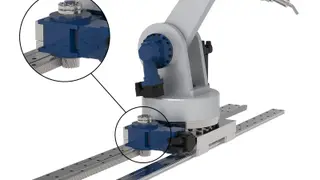
Engineers must weigh trade-offs among rack-and-pinion, ball screws, and linear motors when designing long-travel axes for machinery. Ball screws suffer from whip beyond roughly two to three meters, causing wear and potential failure, while rack-and-pinion systems scale nearly infinitely. Linear motors offer a flat, direct-drive alternative but may not suit every application.
Long-travel axes in industrial robotics face a fundamental trade-off: ball screws offer high precision but become unreliable beyond roughly two to three meters due to a whip effect that causes vibration and premature wear. Rack-and-pinion systems avoid this by scaling nearly infinitely—multiple rack sections can be joined for extended travel, with lower component costs than linear motors. Linear motors provide speed and precise control but require constant power to hold position, generate magnetic fields that attract debris, and carry higher per-meter costs from permanent magnets and electromagnets. A rack-and-pinion setup, typically paired with a gearbox and motor, holds position without continuous power draw and is often less expensive overall, making it a practical choice for many long-travel applications.
This comparison could influence how manufacturers design automated systems for warehouses, assembly lines, or large-scale machining. Choosing rack-and-pinion may lower upfront costs and maintenance for long paths, benefiting small and mid-sized firms. However, linear motors’ speed and precision could remain essential for high-end tasks like semiconductor fabrication. The trade-offs may shape equipment reliability, energy use, and workplace safety—particularly around magnetic hazards—affecting engineers, operators, and ultimately consumers through product costs and quality.