Industrial Drone Autonomy Faces Real-World Challenges from Environmental Complexity
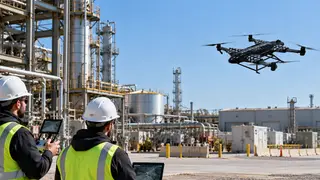
Autonomous drones struggle with real-world industrial environments due to factors like unreliable GNSS signals, reflective surfaces distorting depth sensors, and dynamic obstacles such as moving equipment. These challenges reveal that subsystems like navigation, perception, and control must work together under uncertain conditions, where failures in one area can cascade across the entire system. The article emphasizes that true reliability requires not just accurate individual components but also the ability to detect when system estimates become untrustworthy.
In November 2026, reports from industrial drone operations revealed persistent challenges in deploying autonomous UAVs in real-world settings such as steel-processing facilities and energy infrastructure sites. Despite successful controlled tests, drones failed during actual inspections due to GNSS signal degradation from metallic structures, multipath interference, and reflective surfaces that distorted depth sensing. These issues were compounded by dynamic environmental factors like wind gusts and moving machinery, which disrupted flight stability. The core problem lies not in isolated sensor failures but in the interdependence of navigation, perception, and control systems—where a single malfunction in one subsystem can cascade through the entire autonomy stack. For instance, degraded GNSS signals led to drift in absolute positioning, while visual-inertial odometry (VIO) and LiDAR-based odometry struggled with featureless or repetitive environments, undermining map consistency. Engineers at companies like ZenaDrone, referenced in a case study, found that even with advanced SLAM frameworks like VINS-Mono and LIO-SAM, maintaining global accuracy remained elusive. The distinction between local consistency and global accuracy became critical when repeatable inspections at known asset locations were required. The unresolved challenge is not achieving flawless autonomy but ensuring predictable behavior within a defined operational envelope—especially when that envelope is exceeded. What remains unclear is how regulatory bodies will define acceptable risk thresholds for such systems, or how developers will validate trustworthiness in real-time without relying on idealized test conditions.
The challenges highlighted in industrial drone autonomy may slow the adoption of fully autonomous inspection systems in high-risk sectors like energy, manufacturing, and infrastructure maintenance. Workers in these fields may see delayed automation benefits, while safety teams face increased scrutiny over system reliability. The broader impact could ripple into insurance models, as underwriters grapple with new risk profiles for drone operations in complex environments. This situation echoes early concerns around autonomous vehicles, where real-world unpredictability—such as adverse weather or unexpected pedestrian behavior—undermined lab-tested performance. Just as self-driving car developers had to shift from perfect performance to robust failure modes, drone developers may now need to prioritize detectable degradation over continuous operation. The next critical step could involve standardized testing protocols that simulate industrial complexity, possibly led by industry consortia or regulators. What remains uncertain is whether current engineering approaches can achieve sufficient trustworthiness without human oversight, or if hybrid human-in-the-loop systems will remain the norm for the foreseeable future.