New Model Accurately Predicts Fine-Tuning Duration Using Real-World Data
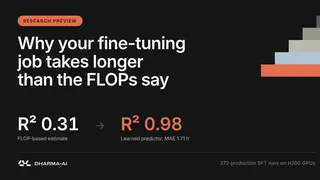
A team from Dharma-AI analyzed 272 real-world supervised fine-tuning jobs on NVIDIA H200 GPUs to improve time estimation accuracy. Their CatBoost-based predictor, which uses pre-dispatch data like evaluation cadence and checkpoint policy, achieves 98% accuracy (R² = 0.98) with a mean error of just 1.71 hours, far surpassing traditional FLOP-based estimates. The findings highlight how training-specific factors and nonlinear interactions significantly impact job duration, enabling better GPU cluster scheduling.
In November 2026, a team from Dharma-AI analyzed 272 real-world supervised fine-tuning (SFT) jobs executed on NVIDIA H200 GPUs within a corporate production environment, covering a total of 7,382 GPU-hours. Their goal was to improve the accuracy of end-to-end duration predictions for AI training jobs, which are critical for efficient GPU cluster scheduling. The team developed a CatBoost-based regression model that leverages pre-dispatch data—including evaluation cadence, checkpoint policy, per-GPU token volume, and model metadata—achieving an R² of 0.98 and a mean absolute error of just 1.71 hours in 5-fold cross-validation. This dramatically outperforms traditional FLOP-based estimates, which had an R² of only 0.31 and a mean error of 12.41 hours. The study highlights that compute-only models fail to account for real-world overheads such as model loading, I/O contention, and periodic evaluations, which vary significantly across configurations and scale nonlinearly with job size. The model’s features were derived from job configurations and metadata, with no runtime data used, making it suitable for scheduling decisions before job dispatch. The work was conducted using Hugging Face Transformers and Unsloth, with results applicable across LoRA and full fine-tuning methods up to 15 billion parameters. The team plans to publish the full paper on arXiv, suggesting this is a step toward broader adoption of data-driven scheduling in AI infrastructure.
The background for this work lies in the persistent inefficiency of AI cluster management, where inaccurate time estimates lead to underutilized GPUs or delayed experiments. Prior to this study, most teams relied on theoretical FLOP calculations, which ignore real-world bottlenecks. Dharma-AI’s research builds on growing recognition that training time is not just a function of compute but also of system-level interactions. The team’s motivation is clear: better predictions enable more efficient resource allocation, reducing idle time and improving delivery timelines. The model’s success suggests that machine learning can be applied not just to model training but to infrastructure orchestration itself. However, the study’s scope is limited to SFT jobs on H200s, and its generalizability to other architectures, model types, or cloud environments remains untested. It is also unclear how the model would perform under different workloads or with dynamic scaling. What’s next may include integration into production schedulers, expansion to other training paradigms, and public release of the model or codebase—though this is not yet confirmed.
This development could significantly improve efficiency in AI infrastructure management, particularly in large organizations running shared GPU clusters. By reducing scheduling errors from an average of over 12 hours to under 2, teams may achieve near-optimal GPU utilization, lowering operational costs and accelerating model iteration cycles. The impact may ripple through research labs, startups, and cloud providers, where time-to-results is a key performance metric. Second-order effects could include reduced demand for additional hardware, as better scheduling maximizes existing capacity, and a shift toward data-driven rather than rule-based cluster management. A comparable precedent is the adoption of predictive analytics in cloud resource allocation during the early 2010s, which transformed how companies like Amazon and Google managed server loads. However, unlike those systems, this model is trained on real-world training workflows, making it more context-specific. The broader implication is that AI infrastructure is becoming increasingly self-optimizing—not just in training, but in deployment and scheduling. What to watch for includes whether Dharma-AI opens the model or data, how other organizations adapt similar approaches, and whether such tools become standard in training frameworks like Ray or Kubeflow. The success of this method may also encourage more investment in observability and feature engineering for AI workflows.