Scaling Mixture-of-Experts Models to 180 Billion Parameters with Just 32GB of RAM
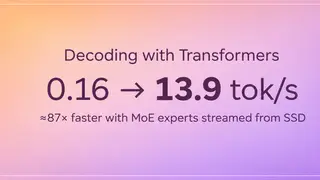
Researchers have demonstrated a new method for efficiently running large Mixture-of-Experts (MoE) models with 180 billion parameters using only 32GB of RAM, significantly reducing hardware demands. The approach leverages expert streaming and memory optimization techniques to enable inference on consumer-grade hardware. This breakthrough could make highly complex models more accessible for on-device applications.
Researchers have developed a novel technique enabling the inference of a Mixture-of-Experts (MoE) model with 180 billion parameters using only 32GB of RAM—a significant reduction in hardware requirements compared to previous implementations. This achievement demonstrates that large-scale models can operate efficiently on consumer-grade devices, which traditionally require high-end GPUs or specialized hardware. The method relies on expert streaming and memory optimization, allowing the system to load only necessary model components during inference rather than storing the entire model in memory at once. This innovation directly addresses a longstanding barrier to deploying complex AI models on edge devices such as smartphones, tablets, and embedded systems.
While the specific research team, institution, or publication date is not provided, the work builds on prior advancements in sparse modeling and efficient inference, particularly the growing interest in MoE architectures for balancing performance and resource use. Earlier efforts in large model deployment have often been limited by memory constraints, requiring cloud-based processing and raising concerns about latency, privacy, and data sovereignty. By enabling on-device operation, this breakthrough may shift the paradigm toward decentralized AI, where sensitive data remains local and processing is faster.
The implications are particularly relevant for open-source communities and developers seeking to deploy powerful models without relying on proprietary cloud infrastructure. Organizations focused on privacy, accessibility, and open innovation stand to benefit from the reduced hardware demands. However, it remains unknown whether the model’s training process still requires substantial resources, or if the efficiency gains are limited to inference. The next steps likely involve testing the method across diverse hardware platforms and evaluating real-world performance in applications like real-time language translation, on-device personal assistants, and autonomous systems.
This development could significantly expand access to advanced AI capabilities on personal devices, potentially empowering users in regions with limited cloud infrastructure or data privacy concerns. By reducing reliance on centralized servers, it may strengthen user control over personal data and reduce latency in time-sensitive applications. The shift toward on-device AI may also influence the design of future hardware, encouraging manufacturers to prioritize efficient, scalable processing over raw computational power. A comparable precedent is the rise of on-device speech recognition in smartphones, which initially required cloud processing but later became feasible through optimized local models. If this MoE breakthrough scales widely, it may accelerate the adoption of AI in low-resource settings and foster innovation in open-source AI ecosystems. However, challenges remain around model accuracy, energy consumption, and compatibility with existing software stacks. The broader impact will depend on whether the technique can be generalized to other model types and integrated into mainstream development tools. What to watch for next includes open-source releases, benchmarking across devices, and potential industry partnerships.