M.C. Escher’s Art Reveals Deep Mathematical Insights Despite No Formal Training
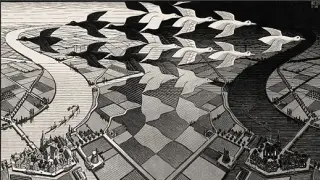
The National Museum of Mathematics in New York City is hosting an exhibition titled 'Mathematics and the Art of M.C. Escher,' highlighting how the artist’s work, created without formal math education, explored complex mathematical concepts like symmetry, tiling, and impossible perspectives. Escher was inspired by the tile patterns of the Alhambra in Granada, Spain, which led him to experiment with geometric patterns and spatial illusions. His art, though rooted in visual observation and creativity, has become a lasting source of inspiration for mathematicians and researchers in geometry.
In 1938, M.C. Escher created *Day and Night*, a woodcut depicting a landscape where birds transform from black to white as they fly across a field, symbolizing the duality of day and night. This work, now part of the National Museum of Mathematics (MoMath) exhibition “Mathematics and the Art of M.C. Escher,” exemplifies how Escher’s art, developed without formal mathematical training, embodied complex concepts like symmetry, tiling, and impossible perspectives. His journey began in 1922 after visiting the Alhambra in Granada, Spain, where he was captivated by the intricate tile patterns. Inspired, he began experimenting with tessellations—repeating geometric patterns that fill a plane without gaps. In 1954, Escher’s work was showcased at the International Congress of Mathematicians in Amsterdam, where he met geometer H.S.M. Coxeter. Their correspondence, which lasted until Escher’s death in 1972, profoundly influenced his later works, including *Symmetry Drawing No. 123* (1964), which reflects patterns from mathematician George Pólya’s 17-fold classification of plane symmetry groups. Dutch crystallographer Carolina MacGillavry later recognized Escher’s intuitive mastery of color symmetry, publishing a 1965 book that affirmed his deep, untrained understanding of mathematical principles. Despite his artistic success, Escher expressed loneliness in a 1959 letter, noting that his work had entered a realm understood by few. The MoMath exhibition, running through February 8, 2027, highlights how Escher’s visual intuition prefigured formal mathematical discoveries. What remains unresolved is whether his methods could be formalized into new mathematical frameworks or inspire AI-driven pattern generation in art and design.
Escher’s legacy may influence how AI systems interpret and generate visual patterns, particularly in fields like computational geometry and generative art. His intuitive grasp of symmetry and tessellation—developed without formal training—could inform machine learning models designed to discover mathematical structures in visual data. Institutions like MoMath and research groups in computational mathematics may use his work as a benchmark for AI creativity, testing whether algorithms can replicate or extend his insights. A comparable precedent is the 19th-century collaboration between artist William Blake and mathematician William Rowan Hamilton, where artistic visions helped conceptualize abstract ideas. Escher’s case may similarly demonstrate that non-mathematical creativity can precede and inspire formal theory. The broader impact could extend to education, where his art is already used to teach geometry and symmetry in schools. If AI systems begin to analyze and replicate Escher-like patterns, they may challenge traditional notions of mathematical discovery, suggesting that creativity and intuition can precede formal proof. What to watch for is whether AI tools will be used to generate new Escher-like artworks that are indistinguishable from human creations, raising questions about authorship and the role of intuition in science.