Betelgeuse May Devour Companion Star, Triggering a Future Cosmic Blaze
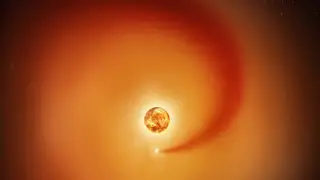
A new study suggests that the red supergiant star Betelgeuse will eventually engulf its recently discovered companion star in a few thousand years, leading to a brilliant eruption visible from Earth. This event would temporarily outshine Venus in the night sky, adding a dramatic prelude to Betelgeuse's eventual supernova explosion. The discovery of the companion, nicknamed 'Betel-buddy,' has reshaped theories about the star's final evolutionary stages.
In November 2026, a new preprint study led by Naunet Leonhardes-Barboza, a graduate student at the University of California, Santa Cruz, suggests that Betelgeuse—the red supergiant star in Orion’s shoulder—will engulf its recently discovered companion star, nicknamed “Betel-buddy,” within the next 10,000 years. This event is predicted to trigger a luminous red nova, an explosive outburst that could temporarily shine 1.5 to three times brighter than Venus in Earth’s night sky, potentially visible even during daylight hours. The study builds on earlier observations, including Betelgeuse’s “Great Dimming” in 2019, when the star inexplicably faded due to dust clouds formed from ejected material. More recently, evidence for a companion star emerged, prompting new models of stellar evolution. Simulations tested three possible masses for the companion—0.7 to two solar masses—and found that more massive companions would produce brighter eruptions. The event is expected to last only a few days, unlike historical supernovae such as Tycho’s in 1572, which remained visible for months. While Betelgeuse itself will eventually explode as a supernova, this pre-merger brightening may offer a rare observational window into stellar dynamics before a red supergiant’s final collapse.
The research team, including astrophysicist Jared Goldberg from the Flatiron Institute’s Center for Computational Astrophysics (not part of the study), emphasizes that such events could serve as signposts for detecting similar mergers in distant star systems. The detailed modeling of Betelgeuse’s system—unprecedented due to its proximity and extensive observational history—offers a unique opportunity to test theories about stellar interactions. However, the exact timing of the merger remains uncertain; while it may occur within 10,000 years, no precise date can be given. The nature and mass of Betel-buddy are still not fully confirmed, and whether the companion will be fully consumed or partially disrupted remains a modeling assumption. What is clear is that this event, if observed, would represent one of the most closely studied stellar phenomena in human history.
The discovery could inspire renewed public interest in astronomy, particularly among younger generations who may witness the “Great Brightening” as a visible celestial event. Unlike past supernovae, which were observed only after they occurred, this prediction allows for long-term observation planning and educational outreach. Institutions like planetariums, science museums, and space agencies may develop programs around the anticipated event, potentially boosting STEM engagement. The broader impact could extend to observational astronomy, where researchers might refine detection algorithms to identify similar luminous red novae in distant galaxies—events previously mistaken for supernovae or variable stars. This mirrors how Tycho Brahe’s 1572 supernova revolutionized early modern astronomy by challenging the notion of an unchanging heavens. Today, Betelgeuse’s impending merger may similarly recalibrate how astronomers interpret transient events across the cosmos. What to watch for next is whether other red supergiant systems show signs of companionship or pre-merger activity, and whether space-based telescopes like James Webb can detect early-stage dust or gravitational signatures. The event remains speculative but could shape future observational strategies in astrophysics.