Deb Shoquist and Global Partners Drive NVIDIA's AI Hardware Innovation Through Supply Chain Mastery
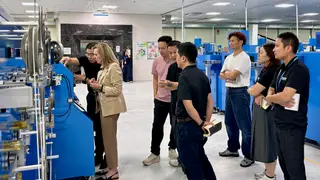
Deb Shoquist, NVIDIA's operations chief, leads a global network of manufacturing partners including TSMC, Foxconn, and Lumentum to enable year-round deployment of cutting-edge AI technologies. Her approach emphasizes deep technical collaboration, trust, and continuous innovation, with regular on-site visits to factories in Taiwan, Vietnam, China, Korea, and the U.S. The supply chain’s success stems from long-standing relationships and problem-solving under pressure across multiple generations of chip production.
In November 2026, Deb Shoquist, NVIDIA’s operations chief, was honored with the Dr. Lisa Su Woman of Innovation Award, spotlighting her pivotal role in managing one of the world’s most advanced semiconductor supply chains. Her leadership spans a global network including TSMC, Foxconn, Lumentum, Amphenol, Coherent, and Wistron, with long-standing partnerships dating back over two decades—TSMC since 1998, SPIL and KYEC since before the turn of the century. The supply chain enables year-round deployment of cutting-edge AI hardware, including complex components like Amphenol’s cable cartridge, which features 1,500 precision cable legs with a defect rate below 1 DPPM, produced across over 100 automated lines in Vietnam. Shoquist’s approach emphasizes on-site collaboration, with six weeks annually spent visiting factories in Taiwan, China, Korea, Vietnam, and the U.S., where she engages not only executives but frontline engineers and factory workers. This deep engagement has fostered trust-based relationships critical for solving high-pressure challenges across successive chip generations. As NVIDIA evolved from a chip designer to a systems and platform provider, the need for new partners in emerging fields like co-packaged optics (CPO) grew, requiring investment in companies such as Coherent and Lumentum to scale capabilities. The shift demands not just technical prowess but financial commitment and innovation at scale—something only sustained partnerships can deliver.
Shoquist’s model of supply chain leadership could influence how tech giants manage global manufacturing amid rising geopolitical tensions and semiconductor scarcity. By prioritizing long-term relationships, on-site collaboration, and investment in emerging partners, NVIDIA may be setting a benchmark for resilience in high-tech production. This approach may help stabilize supply chains during disruptions, as seen in past crises like the 2020–2022 chip shortage, where rigid supplier hierarchies failed to adapt. Comparable to how Apple’s ecosystem of suppliers evolved through decades of co-development, NVIDIA’s strategy may enable faster scaling of next-gen AI infrastructure. However, it remains unclear whether this model is scalable for smaller firms or replicable in regions with less mature manufacturing ecosystems. The long-term impact on labor practices—especially in high-precision environments like Vietnam—also warrants scrutiny. As demand for AI hardware grows, the ability to sustain such partnerships may determine which companies lead in innovation and market share. What’s next could include broader industry adoption of “co-innovation” frameworks or increased public investment in supply chain infrastructure, particularly in optics and packaging technologies where scale is still emerging.