Cosmic Census Reveals Discrepancies in Dark Energy Theory
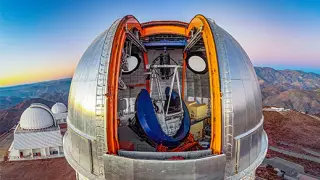
A two-decade-long galaxy survey using the Dark Energy Camera has concluded, revealing data that challenge the standard model of cosmology. The findings suggest inconsistencies in how dark energy, thought to make up two-thirds of the universe, behaves across cosmic time. Scientists now question whether current models fully explain the universe's expansion and structure formation.
The Dark Energy Survey (DES), conducted over 20 years using the 570-megapixel Dark Energy Camera on the Victor M. Blanco 4-Meter Telescope in Chile, has concluded with final results released in May 2026. The survey analyzed data from thousands of supernovas and hundreds of millions of galaxies across billions of years of cosmic history. These findings, combined with data from the Dark Energy Spectroscopic Instrument (DESI), reveal inconsistencies in the standard model of cosmology—the prevailing theory that dark energy, a mysterious force driving the universe’s accelerated expansion, has remained constant over time. The data suggest that dark energy may not behave uniformly across cosmic history, challenging the assumption that it is a fixed property of space itself. This discrepancy implies that either the model is incomplete or that new physics beyond current understanding—such as evolving dark energy or modifications to general relativity—may be required.
The project was initiated by cosmologist Joshua Frieman in the late 1990s, inspired by the 1998 discovery of accelerating expansion via distant supernovas. That breakthrough, which earned a Nobel Prize, established dark energy as a cornerstone of modern cosmology, accounting for roughly two-thirds of the universe’s total energy content. The DES was designed to test this model with unprecedented precision. Key institutions involved include the University of Chicago, Lawrence Berkeley National Laboratory, Fermilab, and the U.S. Department of Energy. Scientists like Simone Ferraro now describe the standard model as showing “cracks,” signaling a return to uncertainty after decades of stability. What remains unresolved is whether these anomalies are statistical fluctuations or evidence of fundamental new physics. The next steps may involve upcoming missions such as the Vera C. Rubin Observatory’s Legacy Survey of Space and Time, which could provide even deeper data to test these emerging tensions.
The findings from the Dark Energy Survey could reshape how society perceives the universe’s fundamental nature, potentially influencing public understanding of science and long-term investment in basic research. While immediate practical applications are unlikely, the implications may ripple through education, policy, and funding priorities for large-scale scientific infrastructure. If the anomalies persist, they may prompt renewed support for next-generation telescopes and space-based observatories, shifting resources from incremental improvements to bold new experiments. Historically, similar paradigm shifts—such as the 1998 supernova discoveries that first revealed dark energy—sparked massive increases in funding and international collaboration in cosmology. The current situation may mirror that earlier moment: a quiet confidence giving way to intellectual uncertainty, which often precedes breakthroughs. Institutions like NASA, the European Space Agency, and national labs could see renewed interest in astrophysics budgets, while private investors might explore space-based data ventures. The broader impact may be cultural—a reminder that even well-established scientific models can be incomplete. What to watch for next is whether the anomalies hold up under independent analysis or if new data from Rubin Observatory or future missions will resolve the tension. The outcome could either solidify a new era of cosmological discovery or deepen the current uncertainty, depending on how quickly consensus forms.