AI-Powered Clinical Reasoning Engine Streamlines Patient Care at Dyania Health
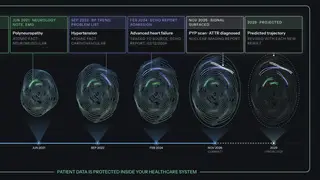
Dyania Health, a New Jersey-based clinical AI company, uses NVIDIA-accelerated computing to power Synapsis AI, a system that analyzes decades of unstructured patient records to surface actionable clinical signals. The tool enables clinicians to quickly identify patients needing attention by connecting findings across years of medical notes, imaging reports, and lab results without leaving data on hospital servers. It operates as an assistive platform, with final decisions made by physicians using evidence traced directly to original records.
In November 2026, Dyania Health, a New Jersey-based clinical AI company, deployed its Synapsis AI platform at Cleveland Clinic to analyze over 7,800 patient records from 2005 to 2021, focusing on aortic valve replacement outcomes. The system processed unstructured data—including echocardiograms, physician notes, and lab results—across decades, identifying patterns predictive of valve deterioration and the need for reintervention at three-, five-, and ten-year intervals. This task, which would have taken clinicians years to complete manually, was accomplished in a fraction of the time using NVIDIA-accelerated computing infrastructure hosted within the hospital’s firewall. Synapsis AI operates as an assistive clinical reasoning engine, generating traceable signals from original records without moving data outside the health system. Dyania leveraged NVIDIA NeMo for model development and TensorRT/TensorRT-LLM to optimize performance on local GPU servers, ensuring speed and compliance with data privacy standards.
The broader context includes growing pressure on healthcare systems to improve care efficiency while managing vast, underutilized medical records. Prior efforts in clinical AI have often struggled with data silos, privacy concerns, or reliance on cloud-based processing. Dyania’s approach addresses these by keeping data on-premises and focusing on interpretability—each insight is tied directly to its source document. Key stakeholders include Cleveland Clinic’s Heart, Vascular & Thoracic Institute, led by Dr. Lars Svensson, who sees predictive modeling as a step toward personalized care. Dyania aims to expand Synapsis AI to other domains like oncology and clinical trial matching. What remains unresolved is the long-term validation of such systems in diverse populations and real-world clinical workflows, as well as regulatory pathways for widespread adoption.
Synapsis AI’s deployment may significantly reduce clinician burnout by automating tedious chart reviews, potentially freeing up time for direct patient interaction. This could improve care quality and provider satisfaction, especially in specialties burdened by documentation. The model’s on-premises operation sets a precedent for privacy-conscious AI adoption in healthcare, possibly influencing how other institutions handle sensitive data. A comparable case is IBM Watson Health’s earlier attempts to use AI in oncology—though it faced criticism for overpromising and poor integration, highlighting the importance of clinician-centered design. Synapsis AI’s focus on traceability and human oversight may avoid similar pitfalls. However, its real-world impact depends on scalability across different health systems and patient populations. Future developments to watch include regulatory scrutiny around AI-driven clinical decisions, the emergence of standardized benchmarks for such tools, and whether hospitals will adopt similar models at scale—could this become a new standard in medical record analysis?