Runway Releases Open-Source Praxis-1 Robotics Model with Industry Partners
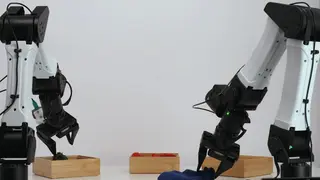
Runway AI has released Praxis-1, a 27B-parameter world action model for robotics, under the Apache 2.0 license with open weights. The model, developed in collaboration with Noble Machines, Standard Bots, and Ultra, demonstrates strong performance on real-world tasks like picking up wooden planks and clearing messy piles. It is now available on GitHub, Hugging Face, and vLLM-Omni, supporting both full fine-tuning and LoRA adaptation across NVIDIA hardware.
On November 12, 2026, Runway AI released Praxis-1, a 27-billion-parameter world action model for robotics, under the Apache 2.0 open-source license with full access to weights and code. Developed in collaboration with Noble Machines, Standard Bots, and Ultra, the model demonstrated high performance on real-world tasks such as picking up wooden planks and clearing cluttered piles—achieving 15 correct attempts out of 15 after just half an hour of example data and clearing a mixed pile six times out of ten. Praxis-1 is now available on GitHub, Hugging Face with LeRobot integration, and via vLLM-Omni with hosted inference on Reactor, supporting both full fine-tuning and LoRA adaptation across NVIDIA hardware ranging from H100 and B200 data center GPUs to Jetson Thor edge devices. It ranks fifth on the RoboLab-120 leaderboard with a 46.2% success rate across 1,200 episodes, outperforming FLUX 3 Action, Cosmos3 Nano, and π0.5. The model is built on Runway’s video foundation models, using a mixture-of-experts diffusion transformer trained to predict both video sequences and robot actions simultaneously, enabling it to generalize across diverse robot embodiments including legged humanoids, six-axis arms, and dual-arm warehouse robots with minimal fine-tuning.
This release follows Runway’s earlier work as a founding member of the Cosmos Coalition, advancing open-world models for physical AI. The decision to make Praxis-1 fully open-weight reflects a strategic commitment to interoperability and hardware developer control, driven by CEO Andy Chen’s belief that U.S. leadership in physical AI depends on open, adaptable systems. Runway aims to scale real-world deployments with partners across industrial sites, warehouses, and factories, learning from actual conditions to iteratively improve the model. What remains unresolved is how widely Praxis-1 will be adopted beyond early partners, whether its performance scales consistently across untested environments, and how regulatory or competitive dynamics may affect open-source robotics adoption in sensitive sectors.
Praxis-1 could significantly lower barriers for hardware developers by offering a powerful, adaptable foundation model that reduces the need for extensive custom training. This may accelerate innovation in industrial automation, logistics, and manufacturing, particularly among smaller firms lacking large data or compute resources. The model’s ability to generalize across different robot types—humanoids, arms, dual-arm stations—suggests a shift toward more modular, reusable AI policies, potentially disrupting traditional closed-system robotics platforms. Comparable to the open-source revolution in software with Linux or TensorFlow, Praxis-1 may catalyze a new ecosystem where hardware and AI evolve together. However, its real-world impact depends on deployment reliability, safety oversight, and integration with existing industrial workflows—areas not yet addressed in the release. Future developments to watch include how quickly competitors respond with similar open models, whether regulatory bodies begin assessing liability for autonomous actions, and whether open-source robotics gains traction in regulated environments like healthcare or defense.