Ryugu May Be Oldest Known Asteroid, Pre-Dating Chondrules by Millions of Years
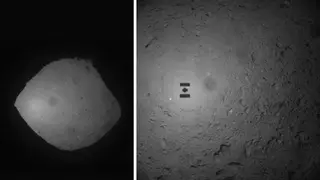
Asteroid Ryugu likely formed less than two million years after the solar system's first solids, making it older than most chondrules found in carbon-rich meteorites. Analysis of dolomite and oxygen isotopes in samples collected by Japan's Hayabusa2 mission indicates the asteroid formed around 4.565 billion years ago, before widespread chondrule formation. The heat needed to create dolomite suggests its parent body took at least a million years to accumulate, placing Ryugu among the earliest planetesimals.
Asteroid Ryugu, sampled by Japan’s Hayabusa2 mission, may be among the oldest known planetesimals in the solar system, forming just under two million years after the first solids emerged—around 4.565 billion years ago. This predates the widespread formation of chondrules, the molten droplets common in carbon-rich meteorites, which are typically dated to a few million years later. Researchers identified dolomite in a Ryugu grain, using its manganese-chromium isotope ratios to date its formation, and analyzed oxygen isotopes to infer that water temperatures reached about 92°C during crystallization. The heat required for this process suggests the parent body took at least a million years to accumulate, indicating early planetary building began almost immediately after the solar system’s inception. The study, published in Science, was led by Ann Nguyen of NASA’s Johnson Space Center, who used these methods to argue that Ryugu formed during the first wave of planetesimals, before chondrules became widespread.
This conclusion builds on longstanding theories about how planets form from dust and ice in protoplanetary disks. The early formation of Ryugu supports models where planetesimals emerged rapidly within the first million years of solar system history, with later generations forming as chondrules became abundant. While some alternative dating methods suggest chondrules formed earlier, the manganese-chromium system used here is still being refined, and the findings remain subject to further validation. The research team plans to apply the same techniques to samples from asteroid Bennu, collected by NASA’s OSIRIS-REx mission, to determine whether the two asteroids share a common origin. If confirmed, this could reveal that some of the solar system’s earliest building blocks were part of a shared population.
The discovery may reshape how scientists understand the timeline and mechanisms of planetary formation, suggesting that planetesimals formed rapidly and in waves rather than gradually. This could influence future space missions targeting primitive bodies for sample return, as well as models used to predict asteroid composition and behavior. Institutions like JAXA and NASA may prioritize early-formed asteroids for future exploration, potentially altering mission design and resource allocation. The findings also highlight the value of international collaboration—Hayabusa2 and OSIRIS-REx represent shared scientific goals across nations. A comparable precedent is the 2019 revelation that some meteorites contained presolar grains older than the solar system itself, which similarly challenged assumptions about early cosmic history. What may follow is a shift in how planetary science interprets meteorite data, with more emphasis on identifying primordial materials. Researchers will likely scrutinize other samples for similar signatures, and future missions could be designed to test these age-dating methods in situ.