Balancing Waves and Research: A Scientist-Surfer’s Dual Career Path
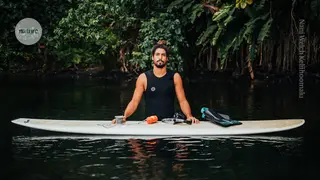
Cliff Kapono, an assistant professor at Arizona State University's School of Ocean Futures, combines his role as a marine conservation scientist with a career as a professional free surfer. His research focuses on coral microbiomes and the ecological dynamics of surf breaks, integrating ocean observation from surfing into scientific inquiry. He dedicates about 15% of his work year to surfing-related activities while maintaining a primary focus on research and teaching.
Cliff Kapono, a Native Hawaiian assistant professor at Arizona State University’s School of Ocean Futures in Hilo, Hawaii, has built a dual career as a marine conservation scientist and a professional free surfer. His research focuses on coral microbiomes and the ecological dynamics of surf breaks, with findings published in May 2026 highlighting the need for integrated frameworks to protect surf ecosystems. He dedicates approximately 15% of his academic work year—around nine months—to surfing-related activities, including content creation for social media and endorsement partnerships, while maintaining a primary focus on research and teaching. His journey began during graduate studies at the University of California, San Diego, where he faced intense lab demands despite being surrounded by ocean views. In 2015, during his third year of a PhD in chemistry, Kapono redefined success by setting boundaries that allowed him to return to surfing as a mental health practice and scientific complement. This shift coincided with the emergence of paid surf opportunities, which he now integrates into his academic role under institutional flexibility for non-conflicting outside work. The broader context includes persistent underrepresentation of Native Hawaiians and Pacific Islanders in STEM—only 0.3% of U.S. STEM degree holders as of 2026—making Kapono’s path both personal and symbolic. His work draws on lived experience, cultural connection to the ocean, and interdisciplinary insight, challenging traditional academic compartmentalization. What remains unresolved is how scalable this model is across disciplines or institutions, particularly in fields with less flexible time structures or fewer opportunities for public-facing roles.
Kapono’s story may inspire a reevaluation of how academic success is measured, especially in environmental sciences where field observation and cultural knowledge are increasingly valued. His integration of surfing into scientific inquiry could influence how universities support interdisciplinary careers, particularly for underrepresented groups who bring unique perspectives from their communities. The model might encourage institutions to expand flexible work arrangements that allow researchers to engage with ecosystems through lived experience, potentially enhancing data quality and public engagement. A comparable precedent is the rise of citizen science initiatives, where non-academics contribute meaningfully to research—though Kapono’s case is distinct in its formal academic legitimacy and high visibility. The broader impact could ripple into STEM education, where role models like Kapono may increase retention among Indigenous students by demonstrating that identity and expertise are not mutually exclusive. However, it remains uncertain whether such dual careers can be replicated outside elite institutions or in disciplines with rigid funding cycles. What to watch for is how academic hiring and promotion systems adapt—whether they begin to recognize experiential knowledge as rigorously as traditional publications.